And most can't answer these disputes cleanly.
One Visitor Standard for All PepsiCo Sites.
Building on existing VisitorOS adoption at 350+ PepsiCo sites, FacilityOS delivers a single system of record that establishes enterprise-wide consistency, visibility, and governance across all facilities.


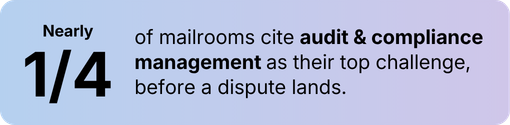
We asked mailroom and facility professionals to name their biggest day-to-day challenge in the mailroom. More respondents pointed to audit management and chain of custody tracking than to any operational challenge, including handling high package volume or preventing lost deliveries.
Which of the following are your biggest day-to-day challenges in the mailroom?
- 24% Audit and compliance management
- 18% End-to-end chain of custody tracking
- 16% Manually logging incoming packages
- 14% Handling high volume with limited staff
- 10% Preventing lost or delayed deliveries
- 10% Sorting and routing items accurately
- 7% Responding to "Where is my package?" inquiries

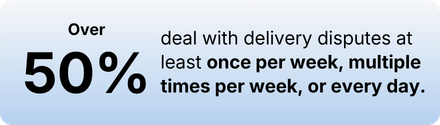
We asked how often questions or disputes arise about how an item was handled, delivered, or signed for in their operation. The responses are more concentrated toward frequent than most would expect.

How often do questions or disputes arise about how an item was handled, delivered, or signed for in your operation?
- 37% Multiple times a week or daily
- 34% Weekly
- 29% Monthly or rarely

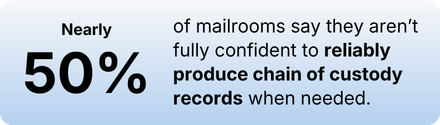
We asked mailroom and facility professionals how confident they are in their ability to produce accurate, audit-ready chain of custody records when needed. The middle of the distribution is where the risk lives. Close to 50% respondents say they are either neutral or only somewhat confident, meaning records exist, but whether they hold up under scrutiny depends on the situation.
How confident are you in your ability to produce accurate, audit-ready chain of custody records when needed?
- 26% Very confident (complete, searchable, consistently available)
- 25% Neutral (depends on the item or situation)
- 25% Somewhat confident (records exist but require manual effort)
- 13% Not very confident (gaps or inconsistencies are common)
- 11% Not confident at all (difficult to produce reliable records)

Closing Insight
Chain of Custody Expectations Have Changed.
Most Mailroom Processes Haven't.
What the data reflects is a shift in what mailrooms are being asked to do. Accountability and chain of custody tracking now rank among the most common daily pressures, alongside the operational work of moving packages. When disputes arrive, the ability to answer them depends on how well the day-to-day process captures and retains delivery information. For most operations, that's where the gap is.
What Mailroom & Facility Teams
Can Do About It
Can Do About It
The survey data points to three areas where mailroom operations consistently create accountability pressure: the daily workload of tracking and logging, the frequency of delivery questions and disputes, and the readiness of chain of custody records when they're needed. Each has a practical path forward.
Replace manual package logging with automated intake
Barcode scanning and automated package intake software creates a time-stamped, searchable record at the moment a package arrives, without manual data entry. Every arrival is logged consistently, and that record is immediately available if a question surfaces later. Teams that make this switch reduce the time spent on intake and eliminate the reconciliation step that makes manual records unreliable under pressure.
Invest in a system that makes chain of custody records retrievable on demand
Mailroom management software with built-in chain of custody tracking stores the full delivery timeline in one place, searchable and accessible without any reconstruction. For teams evaluating where to invest, this is where the return is most immediate: faster resolution, fewer follow-up steps, and documentation that holds up whether the question comes from a recipient, a manager, or an audit.
Choose a solution that captures handoffs internally as well, not only at the dock
Carrier confirmation ends at the building entrance. What happens next, from receiving to routing to final pickup, is the mailroom's responsibility to document. Software with internal parcel tracking at each internal handoff produces a complete chain from dock to recipient. That record is what actually answers accountability questions when they arise.
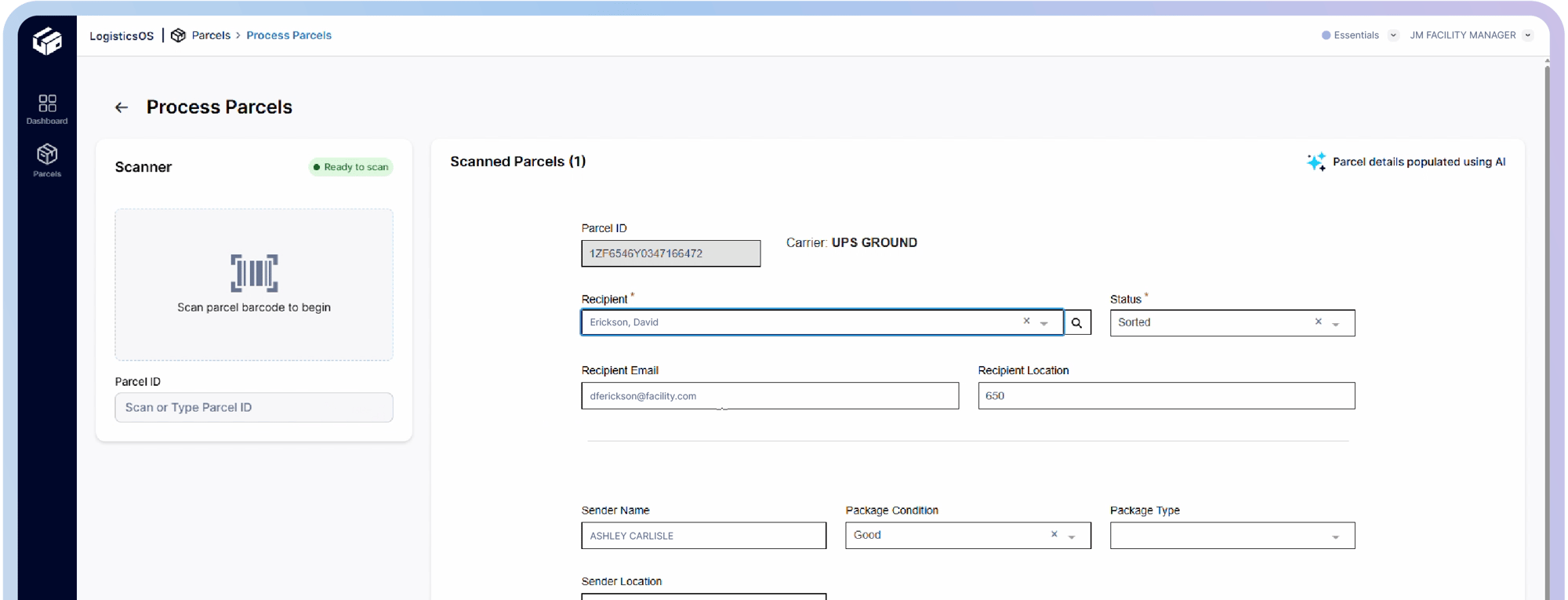
This is what LogisticsOS was built to do
Eliminate Lost Items and Streamline Chain of Custody
LogisticsOS's real-time package tracking ensures a faster and more efficient delivery process for logistics operations. Packages are scanned upon arrival and tracked through each step of your workflow. This reduces delays and minimizes errors while providing a complete chain of custody ensuring compliance with internal and external compliance requirements.

Inconsistent Screening Standards Across Sites
Some sites run on FacilityOS with standardized visitor and contractor screening, while others still operate independently, creating uneven enforcement, compliance gaps, and security exposure.
The question leadership will be asked is:
“Why is this controlled in some buildings, but not all of them?”
Blind Spots Outside the FacilityOS Network
Sites not yet on FacilityOS carry compliance risk that remains invisible at the site level. These often surface only during audits, incidents, or investigations.
The follow-up question:
“Was this an isolated gap or just the first one we found?”
Partial Standardization Drives Overspend
While FacilityOS consolidates vendors and tools at some locations, other sites continue to purchase their own systems, resulting in overlapping contracts, missed enterprise pricing, and limited budget control.
The finance team asks:
“How did we end up paying different prices for the same capability?”
Legacy Systems Become Permanent
Each year a site remains outside the FacilityOS ecosystem, the harder and more expensive it becomes to bring it in.
The hindsight question:
“Why didn’t we extend what was already working?”

[FacilityOS] was easy to roll out and easy to manage. We rolled out 90 locations quickly in about 3 months with the help of [FacilityOS]'s support team.
– Jeff O.

Today, PepsiCo operates with two very different levels of control.
Standardization is how you close that gap.
PepsiCo today With Some Sites Using VisitorOS
1. Standards aren’t fully consistent: Some sites use standardized visitor and contractor screening; others operate independently.
2. Visibility is partial: Central teams see activity in VisitorOS sites, with limited insight elsewhere.
3. Value lives at the site level: Successful outcomes exist, but aren’t consistently used to inform expansion decisions.
4. Tooling varies by site and function: Overlapping tools persist outside standardized locations.
5. AI insights are site-specific: Sites using VisitorOS can analyze trends locally, but insights don’t roll up across the portfolio.
PepsiCo with Enterprise-Wide VisitorOS
1. One consistent enterprise standard: Screening is applied uniformly across all sites, with controlled local flexibility
2. Portfolio‑wide visibility: All sites roll up into a single, real‑time view for audits, risk, and performance.
3. Decisions driven by internal proof: Enterprise teams use site data to quantify ROI and risk reduction.
4. One system of record: EHS, Operations, Facility Managers, Security, and Finance teams align on a shared platform.
5. AI‑ready enterprise governance: Standardized data across sites enables portfolio-wide insights, prediction, and optimization.
Today, PepsiCo operates with two very different levels of control.
Standardization is how you close that gap.
PepsiCo Today with Some Sites Using VisitorOS
Here's what's currently happening:
- Standards aren’t fully consistent: Visitor and contractor screening is standardized at some sites, while others still operate independently.
- Visibility is partial: Central teams see activity in VisitorOS sites, with limited insight elsewhere.
- Value lives at the site level: Successful outcomes exist, but aren’t consistently used to inform expansion decisions.
- Tooling varies by site and function: Overlapping tools persist outside standardized locations.
- AI insights are site-specific: Sites using VisitorOS can analyze trends locally, but insights don’t roll up across the portfolio.
PepsiCo with Enterprise-Wide VisitorOS
Here's what you can expect:
- One consistent enterprise standard: Screening is applied uniformly across all sites, with controlled local flexibility.
- Portfolio-wide visibility: All sites roll up into a single, real-time view for audits, risk, and performance.
- Decisions driven by internal proof: Enterprise teams use site data to quantify ROI and risk reduction.
- One system of record: EHS, Operations, Facility Managers, Security, and Finance teams align on a shared platform.
- AI-ready enterprise governance: Standardized data across all sites enables portfolio-wide analysis, predictive insights, and continuous optimization.