

93% of Facilities Still Rely on Manual Methods to Account for People During Emergencies

Survey data from EHS and facility leaders on where emergency accountability falls short, and what's at risk when it does.
EHS Manager

One Visitor Standard for All PepsiCo Sites. 

Building on existing VisitorOS adoption at 350+ PepsiCo sites, FacilityOS delivers a single system of record that establishes enterprise-wide consistency, visibility, and governance across all facilities.

3 Questions to Understand The State of Emergency Preparedness Today

We asked three questions. The answers kept landing in the same place.

What are our biggest challenges during evacuations
How are we accounting for evacuees during emergencies & drills?
What do we prioritize most in our organization during emergency drills?

64% Say Communication Is the First Thing to Fail During an Evacuation

We asked EHS and facility professionals to name the single biggest challenge during evacuations. The answers didn't center on logistics. They centered on communication.

What is the biggest challenge your team faces during evacuations?

  • 64% Coordinating real-time communication
  • 23% Post-evacuation recordkeeping
  • 13% Accounting for visitors & contractors

Nearly two-thirds of respondents said the same thing: once an evacuation is triggered, reaching the right people at the right time is the hardest part. Incomplete documentation and no way to track non-employees came in second and third, compounding the problem. 

If your team can't communicate during the event, can't prove what happened after, and can't confirm who was on-site to begin with, the response has weak points at every stage.

Paper Roll Calls, Printed Spreadsheets, or Nothing at All

We asked facility professionals how they currently account for employees, visitors, and contractors during an emergency. The majority are using methods that were never designed for real-time headcounts.

frustrated-gc-papers

How does your facility account for people during emergencies?

  • 53% Manual roll calls (paper or verbal)
  • 40% Excel lists or printed logs
  •   7%   No clear Process

93% of respondents are working off manual processes or have no defined process at all. When an emergency hits, accountability depends on clipboards, memory, and spreadsheets that may already be out of date before the alarm sounds. Contractors and visitors rarely show up on those lists. That's the group most likely to be unaccounted for, and the first group regulators will ask about.

Speed Over Readiness: What Teams Actually Optimize Drills For

We asked teams what they prioritize most when running emergency drills. The responses show where attention goes, and what gets left on the table.

What does your team prioritize most during emergency drills?

  • 56% Getting personnel back to work quickly
  • 24% Capturing compliance metrics
  • 12% Maintaining audit trails
  •  7% Everyone on-site understands their role
  •  1% Do not currently prioritize running drills

More than half of teams said their top drill priority is getting people back to work fast. Only 7% said it was making sure everyone on-site knows what to do. That ratio tells a story. Drills that optimize for speed and compliance produce metrics. Drills that optimize for readiness produce people who can actually respond. If the people in your building don't know their role when it's real, the drill looked good on paper and failed in practice.

Closing Insight

The Standard Has Moved.
Most Emergency Processes Haven't Kept Up.

What this data reflects is a shift in what EHS and facility teams are now expected to deliver. Real-time communication, full-site accountability, and audit-ready documentation are the baseline now. But the majority of facilities are still running emergency response on paper roll calls, printed logs, and drills built to satisfy a compliance checkbox rather than prepare people for an actual event.

Teams aren't unaware of the problem. They named it clearly in every response. The disconnect is between what's expected of them and what their current tools and processes can actually do under pressure.

EmergencyOS-ProductSplash

What EHS & Facility Teams
Can Do About It

The survey data surfaces three consistent pressure points: communication during active events, real-time accountability for everyone on-site, and the quality of records produced after it's over. Each one has a direct, practical fix.

utility-one-icon-denim

Retire the clipboard. Muster digitally.

Paper roll calls are slow, incomplete, and unreliable across large or multi-building sites. Digital mustering captures evacuee status through QR scanning, mobile check-ins, or SMS confirmation, giving Safety Officers a live headcount at every muster point without chasing down names on a sheet. The record exists the moment it's needed, rather than being reconstructed after the fact.

utility-two-icon-denim

Bring alerts, roll calls, and reports into one connected workflow

When notifications go out through one tool, roll calls happen on paper, and reports are assembled manually after the fact, information falls through the seams. A purpose-built emergency management system runs the full sequence (alerts, tracking, mustering, return-to-work, and reporting) in one place. That's where the return is most direct: faster response, no information gaps, and documentation that holds up in front of leadership, a regulator, or an insurer.

utility-three-icon-denim

Include visitors and contractors in your emergency process

Visitors, contractors, and temporary workers are often missing from emergency processes entirely because they aren't in the systems facilities rely on during a response. Connecting your emergency platform to visitor management and contractor compliance tools means every person on-site gets included in alerts, tracked at muster points, and documented in the post-event record. That's what answers the first question anyone will ask: "Was everyone accounted for?"
This is what EmegrencyOS was built to do

Full Emergency Oversight, From the First Alert to the Final Report

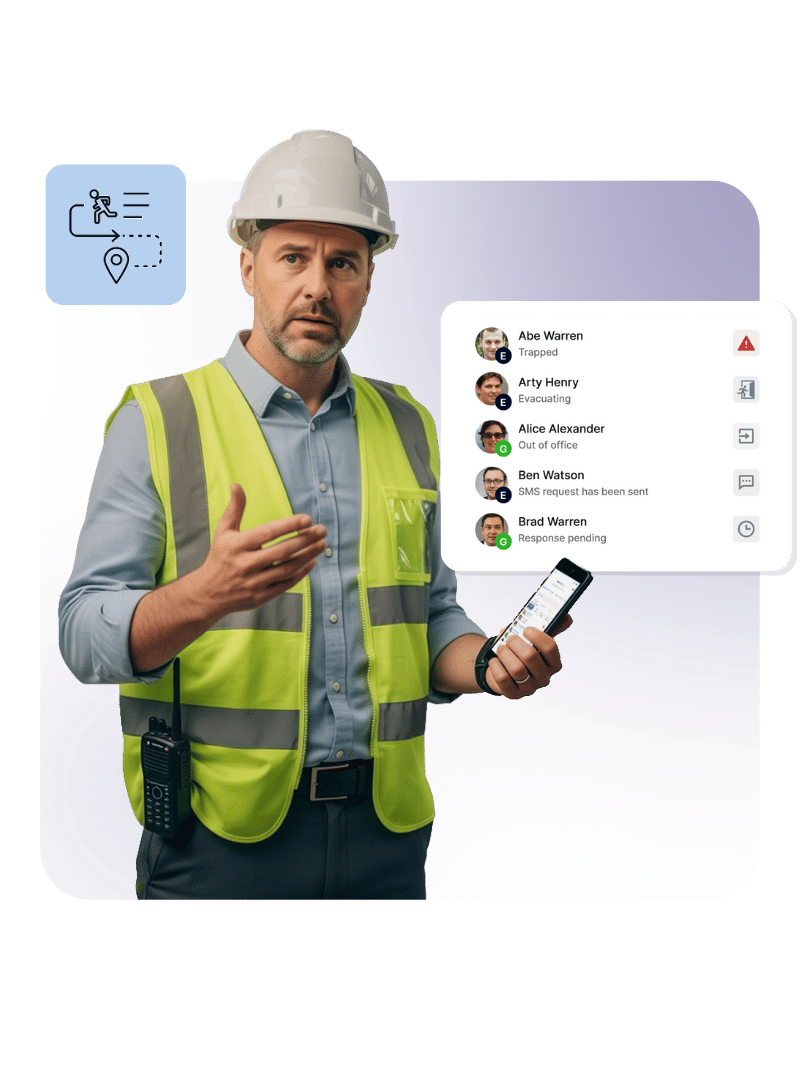
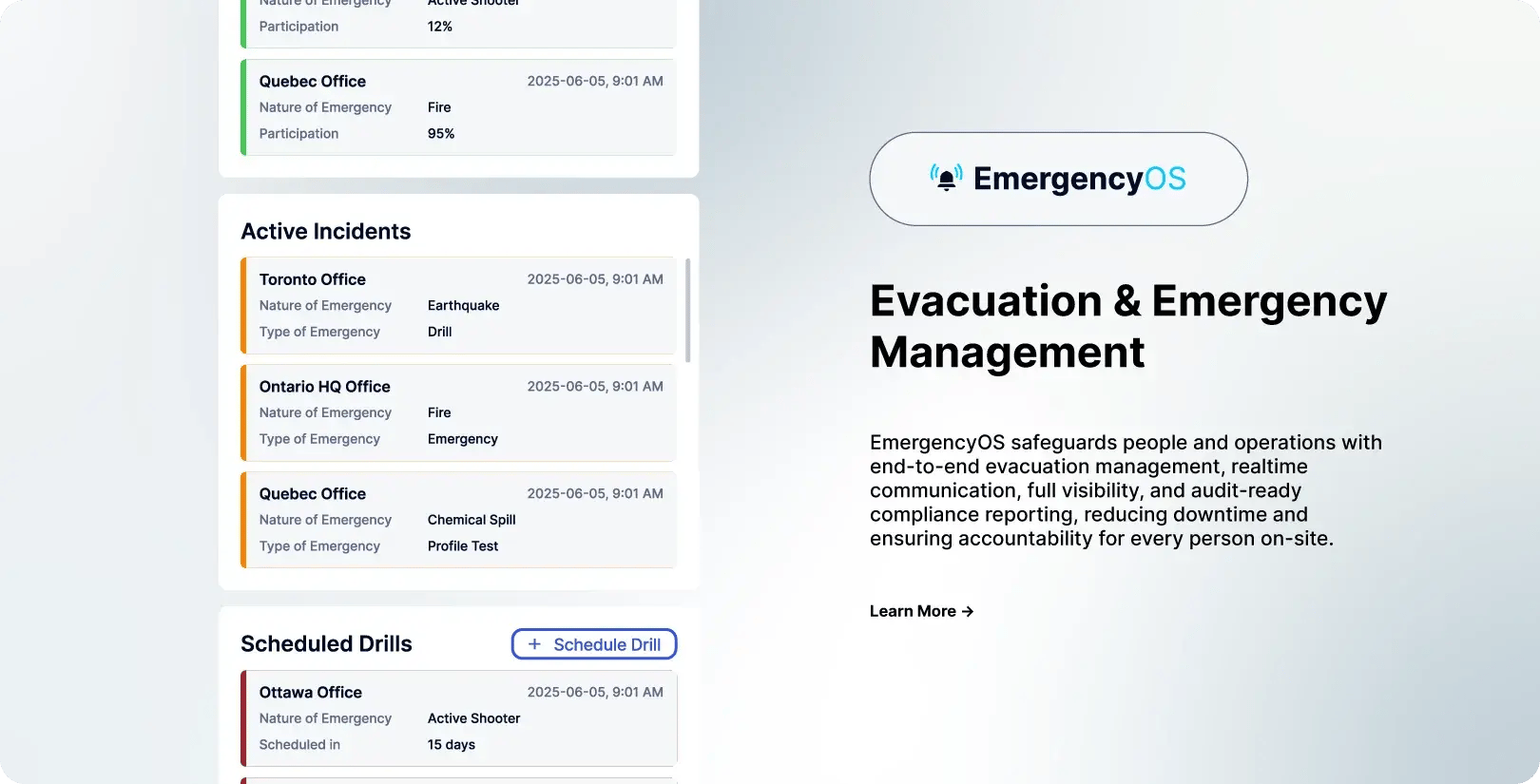
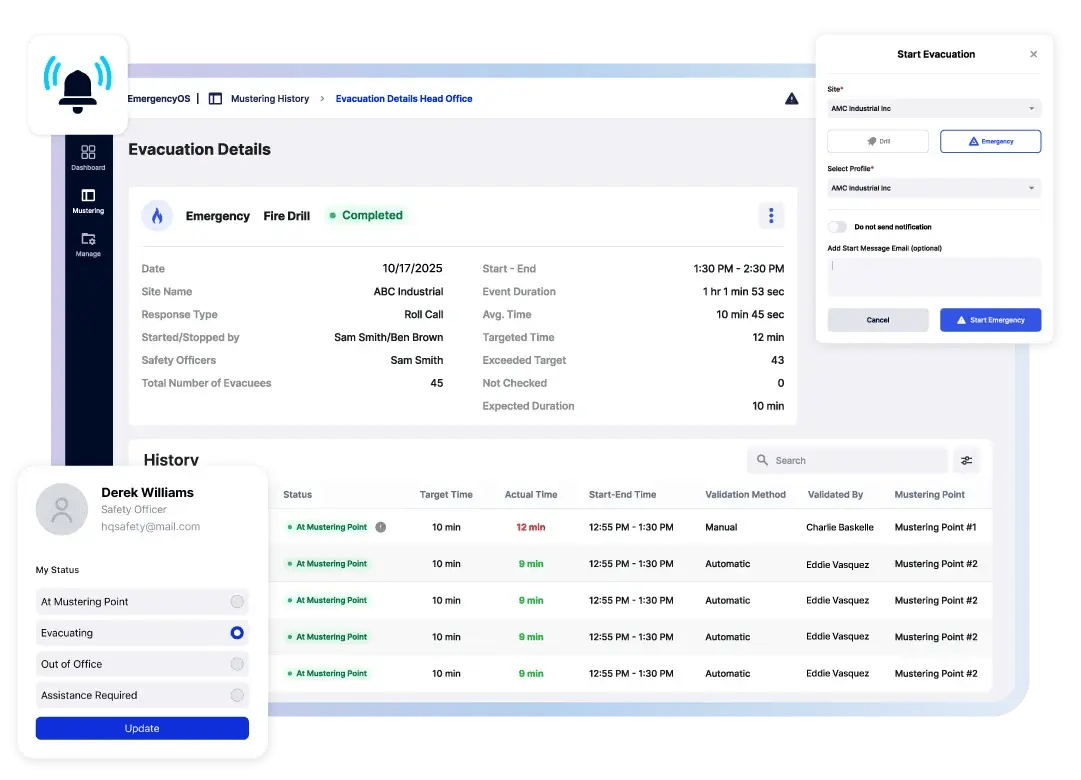
EmergencyOS gives EHS and facility teams direct oversight of every phase of emergency response: alerts, evacuations, mustering, return-to-work, and post-event reporting. Communication reaches employees, visitors, and contractors automatically. Roll calls go digital. And every event produces a complete, audit-ready record without manual assembly.

EmergencyOS- FacilityOS platform module for emergency and evacuation management
VisitorOS-Enhanced-visitor-management


VisitorOS-Enhanced-visitor-management


VisitorOS-Enhanced-visitor-management


VisitorOS-Enhanced-visitor-management


process Inconsistent Screening Standards Across Sites
down-arrow

Some sites run on FacilityOS with standardized visitor and contractor screening, while others still operate independently, creating uneven enforcement, compliance gaps, and security exposure.

The question leadership will be asked is:
“Why is this controlled in some buildings, but not all of them?”


process Blind Spots Outside the FacilityOS Network
down-arrow

Sites not yet on FacilityOS carry compliance risk that remains invisible at the site level. These often surface only during audits, incidents, or investigations.

The follow-up question:
“Was this an isolated gap or just the first one we found?”


process Partial Standardization Drives Overspend
down-arrow

While FacilityOS consolidates vendors and tools at some locations, other sites continue to purchase their own systems, resulting in overlapping contracts, missed enterprise pricing, and limited budget control.

The finance team asks:
“How did we end up paying different prices for the same capability?”


process Legacy Systems Become Permanent
down-arrow

Each year a site remains outside the FacilityOS ecosystem, the harder and more expensive it becomes to bring it in.

The hindsight question:
“Why didn’t we extend what was already working?”

 

G2_logo

[FacilityOS] was easy to roll out and easy to manage. We rolled out 90 locations quickly in about 3 months with the help of [FacilityOS]'s support team.
– Jeff O.


Field Service Leader, Sysco Technology

Today, PepsiCo operates with two very different levels of control.
Standardization is how you close that gap.


PepsiCo today With Some Sites Using VisitorOS

1. Standards aren’t fully consistent: Some sites use standardized visitor and contractor screening; others operate independently.

2. Visibility is partial: Central teams see activity in VisitorOS sites, with limited insight elsewhere.

3. Value lives at the site level: Successful outcomes exist, but aren’t consistently used to inform expansion decisions.

4. Tooling varies by site and function: Overlapping tools persist outside standardized locations.

5. AI insights are site-specific: Sites using VisitorOS can analyze trends locally, but insights don’t roll up across the portfolio.


PepsiCo with Enterprise-Wide VisitorOS

1. One consistent enterprise standard: Screening is applied uniformly across all sites, with controlled local flexibility

2. Portfolio‑wide visibility: All sites roll up into a single, real‑time view for audits, risk, and performance.

3. Decisions driven by internal proof: Enterprise teams use site data to quantify ROI and risk reduction.

4. One system of record: EHS, Operations, Facility Managers, Security, and Finance teams align on a shared platform.

5. AI‑ready enterprise governance: Standardized data across sites enables portfolio-wide insights, prediction, and optimization.

Today, PepsiCo operates with two very different levels of control.
Standardization is how you close that gap.

PepsiCo Today with Some Sites Using VisitorOS

Here's what's currently happening:

  1. Standards aren’t fully consistent: Visitor and contractor screening is standardized at some sites, while others still operate independently.
  2. Visibility is partial: Central teams see activity in VisitorOS sites, with limited insight elsewhere.
  3. Value lives at the site level: Successful outcomes exist, but aren’t consistently used to inform expansion decisions.
  4. Tooling varies by site and function: Overlapping tools persist outside standardized locations.
  5. AI insights are site-specific: Sites using VisitorOS can analyze trends locally, but insights don’t roll up across the portfolio.

PepsiCo with Enterprise-Wide VisitorOS

Here's what you can expect:

  1. One consistent enterprise standard: Screening is applied uniformly across all sites, with controlled local flexibility.
  2. Portfolio-wide visibility: All sites roll up into a single, real-time view for audits, risk, and performance.
  3. Decisions driven by internal proof: Enterprise teams use site data to quantify ROI and risk reduction.
  4. One system of record: EHS, Operations, Facility Managers, Security, and Finance teams align on a shared platform.
  5. AI-ready enterprise governance: Standardized data across all sites enables portfolio-wide analysis, predictive insights, and continuous optimization.

Your FacilityOS Team at PepsiCo

You already have a dedicated FacilityOS team that understands your environment, your sites, and how VisitorOS is being used today. Reach out directly to align on enterprise standardization.

1663271338348
1765386171551

Strengthen Your Site's Emergency Response

Book a 15 minute walkthrough and see if EmergencyOS is right for you.