EHS at the Front Door Research Report
Everyone's Safety Matters
Cross Industry Perspectives on Addressing Safety Gaps for Visitors & Contractors From Over 100 EHS Professionals
A Snapshot of This Year's Report
See how Environment, Health, and Safety Professionals are approaching safety management of non-employees and the challenges shaping accountability, compliance, and site visibility.
EHS Professionals Are Taking on More Risk & Accountability
Across industries, organizations are managing more contractors, vendors, and service providers while navigating increasing regulatory scrutiny and more complex workplace operations. As a result, EHS professionals are being asked to take greater responsibility for people who are not traditional employees—but may still create significant safety and compliance exposure. The survey findings suggest that responsibility is growing faster than operational visibility and process maturity.
+55%
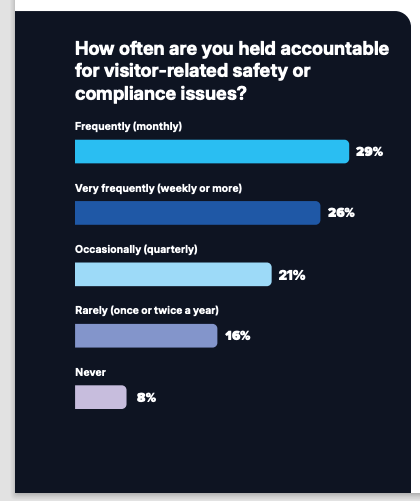
of respondents report being held accountable for visitor-related safety or compliance issues at least monthly,
26%
say their held accountable for visitor-related safety or compliance issuesit happens weekly.
Tracking Visitors Is Fragmented & Inconsistent
Despite growing pressure on EHS professionals to improve accountability and emergency preparedness, many organizations still rely on outdated or inconsistent methods for tracking nonemployees on-site. This visibility gap emerged as one of the strongest themes throughout the survey.
-
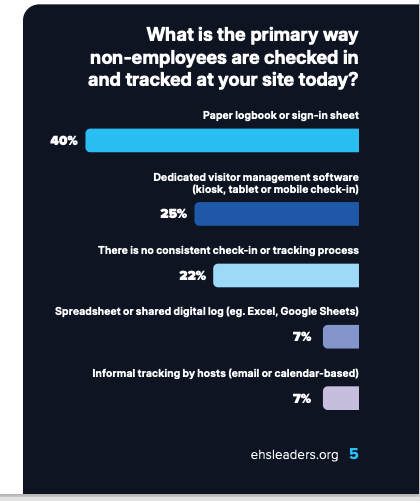
40% of respondents said their organizations still rely on paper logbooks or sign-in sheets,
-
25% reported using dedicated visitor management software.
-
22% said they have no consistent tracking process at all.
One respondent noted, “There isn’t really a good method. Most visitors are escorted by the host.”
Communication Gaps Exist for NonEmployee
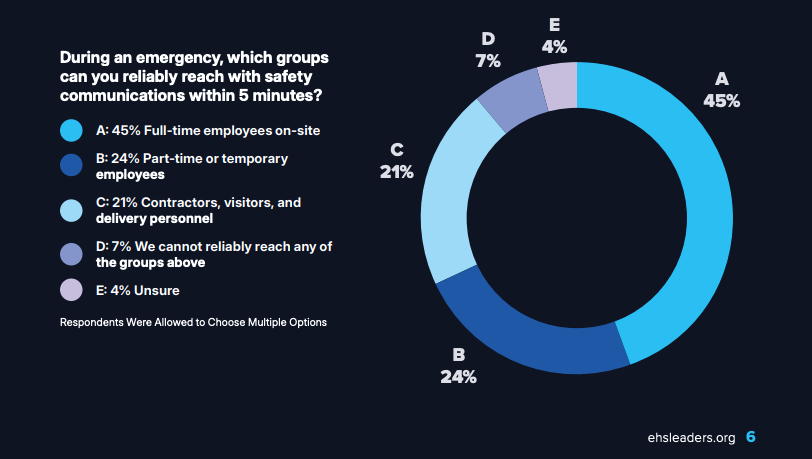
Respondents also reported differences in how quickly they can reach various groups during emergencies.
-
45% of respondents report being able to contact full-time employees within five minutes during an emergency,
-
24% say they can reliably reach part-time or temporary workers,
-
21% report the same capability for contractors, visitors, and delivery personnel.
The findings suggest non-employees may remain harder to contact during emergencies, particularly when organizations rely on disconnected systems or manual processes.
Weak Visibility Creates Audit & Regulatory Risk
The most cited issues involve workplace safety violations and failures related to emergency or hazard procedures.
More than one-third (35%) of respondents report receiving citations, warnings, or fines related to non-employees within the past three years.
EHS Professionals Are Taking on More Risk & Accountability
Across industries, organizations are managing more contractors, vendors, and service providers while navigating increasing regulatory scrutiny and more complex workplace operations. As a result, EHS professionals are being asked to take greater responsibility for people who are not traditional employees—but may still create significant safety and compliance exposure. The survey findings suggest that responsibility is growing faster than operational visibility and process maturity.
+55%
of respondents report being held accountable for visitor-related safety or compliance issues at least monthly,
26%
say their held accountable for visitor-related safety or compliance issuesit happens weekly.
Tracking Visitors Is Fragmented & Inconsistent
Despite growing pressure on EHS professionals to improve accountability and emergency preparedness, many organizations still rely on outdated or inconsistent methods for tracking nonemployees on-site. This visibility gap emerged as one of the strongest themes throughout the survey.
-
40% of respondents said their organizations still rely on paper logbooks or sign-in sheets,
-
25% reported using dedicated visitor management software.
-
22% said they have no consistent tracking process at all.
One respondent noted, “There isn’t really a good method. Most visitors are escorted by the host.”
Communication Gaps Exist for NonEmployee
Respondents also reported differences in how quickly they can reach various groups during emergencies.
-
45% of respondents report being able to contact full-time employees within five minutes during an emergency,
-
24% say they can reliably reach part-time or temporary workers,
-
21% report the same capability for contractors, visitors, and delivery personnel.
The findings suggest non-employees may remain harder to contact during emergencies, particularly when organizations rely on disconnected systems or manual processes.
Weak Visibility Creates Audit & Regulatory Risk
The most cited issues involve workplace safety violations and failures related to emergency or hazard procedures.
More than one-third (35%) of respondents report receiving citations, warnings, or fines related to non-employees within the past three years.
Preview What's Inside
More than half of EHS professionals (55%) are held accountable for visitor-related safety or compliance issues at least monthly. The report digs into why that accountability keeps outpacing their actual authority. And it looks at the day-to-day manual work quietly driving that gap.
Most organizations think they know who's on-site. The report reveals that 40% still rely on a paper logbook to track it. The findings showcase how both processes and organizational barriers are significant contributors to achieving real-time on site visibility.
The results suggest many struggle to quickly confirm who is safely accounted for during high-pressure situations. Safety onboarding remains inconsistent and 64% of organizations depend on hosts to account for non-employees during an emergency.
It creates real regulatory exposure, with more than one-third of respondents citing action tied to non-employees. The report breaks down how that risk connects back to the same root cause running through every other gap.
Insights on Safety, Compliance, & Visibility from 100+ EHS Professionals
Get the full report and insights conducted in partnership with EHSLeaders, the “EHS at the Front Door” survey gathered insights from over 100 EHS professionals to understand the growing disconnect between responsibility and operational control in visitor management and safety programs.
What the Data Tells Us
Frequently Asked Questions
Why do gaps appear in programs that already have strong policies?
How was the survey conducted?
The “EHS at the Front Door” survey from FacilityOS and EHSLeaders was launched in March 2026 and gathered responses from 114 EHS professionals across various industries, including manufacturing, chemicals, construction, utilities, warehousing, transportation, and health services. All percentages in this report have been rounded to the nearest whole percent.
What's included beyond the analysis?
Each stage includes a self-diagnostic, a side-by-side comparison of manual versus systematic processes, and named case studies from facilities including Litehouse, Valmet, Ingersoll Rand, and SMTC Corporation. The guide closes with a gap score card you can use to map your own program across all four stages.