Executive Summary
Most EHS programs at mature facilities have the fundamentals in place. Documented policies. Current training records. Employees who know the procedures. The gaps that create audit exposure, emergency failures, and repeat incidents rarely originate in policy. They originate in the systems, or absence of systems, behind the policy.
When the systems behind a program can't enforce its standards consistently, the standards don't hold. A contractor can appear approved while their certification expired last week. A drill can produce a sign-in sheet and no actionable data. An emergency can trigger without a complete picture of who is on site.


This Guide Examines Four Stages Where the Gap Becomes Visible:
The sections that follow examine where visibility breaks down at each stage, and what closing each gap actually requires.
A Culture of Safety is Only As Strong as the Visibility Behind It
Most EHS leaders have the fundamentals in place. Documented policies. Current training records. Employees who know the procedures. By most internal measures, the program looks solid.
The gap rarely shows up in the documentation. It shows up during an audit when a contractor certification can't be produced. During a drill, when the headcount doesn't include the three vendors working in a restricted area. After an access incident, when it becomes clear that approval was based on an email from six months ago.
"Compliance to regulations is not the goal. It's the outcome of a positive safety culture."
Marvin Flores, 2026 Lab Manager Safety Digital Summit
What audits and near-misses tend to expose is a gap between what a safety program intends and what the systems in place can actually enforce, and that gap often has nothing to do with policy.
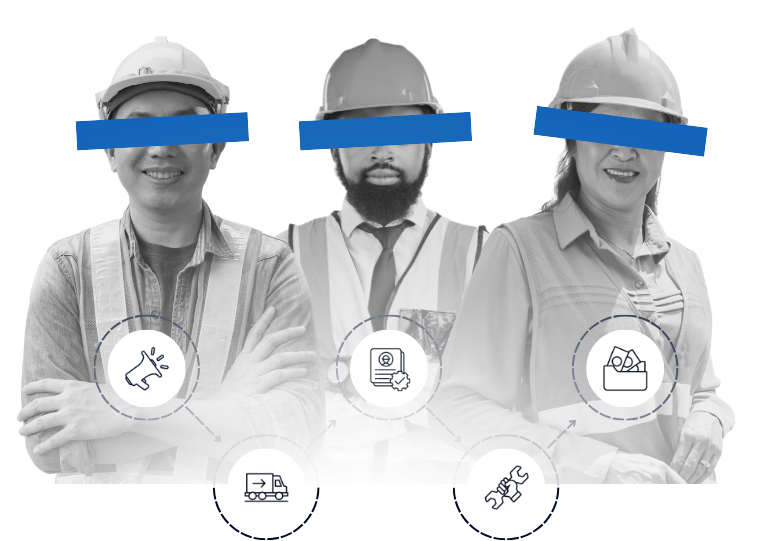
Three categories of people move through industrial and multi-site facilities every day: employees, visitors, and contractors. Most safety programs are built around the first group. The other two are often managed through logbooks, spreadsheets, and manual approvals.
 54% of facilities lack visibility into where visitors and contractors are during an emergency (source).
 38% of facilities cannot communicate with visitors and contractors in real-time during an emergency (source).
Those same manual systems create quieter versions of the same problem for employees: outdated rosters, inconsistent training delivery, drill data that produces a compliance checkbox rather than an improvement signal.
A safety culture is only as strong as the visibility behind it. The sections that follow examine where that visibility breaks down, and what closing each gap actually requires.
Before They Arrive: Setting Expectations Before Anyone Walks In
The pre-entry stage is the first point where a facility's safety expectations are either enforced or deferred.
Credential verification, qualification checks, and site-specific training briefings before arrival aren't administrative formalities. They're the first point where a facility's safety expectations are either enforced or deferred. For most facilities, the systems managing this stage weren't built to enforce anything.
1. The Contractor Credentials Gap
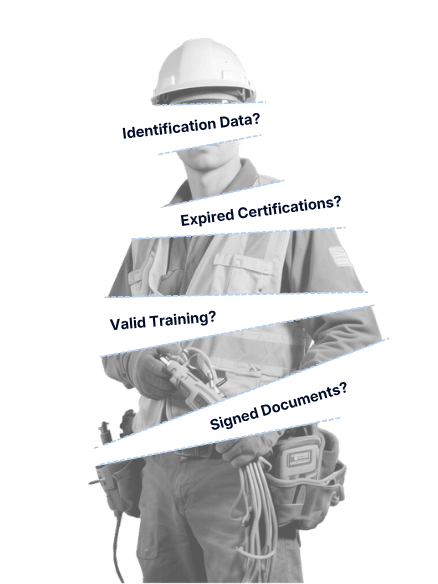 A contractor can appear approved in a shared document while their insurance certificate expired last week. The spreadsheet won't catch it, and nothing in a manual process will stop them from checking in.
The downstream exposure is significant. Nearly one in three organizations face regulatory fines for contractor non-compliance. More than 20% of facilities report denying contractors access daily or weekly due to missing paperwork, creating project delays, admin rework, and overtime across departments in addition to the compliance risk.
OSHA requires contractors to be certified in lockout/tagout, hazardous material handling, and confined space entry. Manual tracking creates gaps that inspectors find, and that create real on-site risk before any inspector ever arrives.
How Facilities Close This Gap
The core shift is moving compliance enforcement upstream: verifying credentials before anyone arrives, rather than discovering a problem at the door.
Facilities that have closed this gap tend to rely on three mechanisms working together:
- Automated Pass-Fail Access Logic
When credentials don't meet requirements, access is denied automatically. That removes the subjective, person-by-person approval decisions that vary by site, by administrator, and by how busy the facility is that day. - Proactive Expiration Alerts
Flagging lapses at 30, 60, and 90 days means contractors and administrators have time to resolve gaps before they become an access issue or an audit finding, rather than catching them at check-in when it's already too late to fix cleanly. - Centralized Documentation
When certifications, insurance certificates, and background checks live in one repository, compliance status is visible to anyone who needs it, before arrival. Chasing records through email threads while a contractor waits at the gate creates both operational friction and documentation gaps that surface later.
Together, these shift the credential management process from reactive to structural. The enforcement happens before arrival, not because of who's staffing the desk.
Is This Gap in Your Facility?
2. The Pre-Arrival Training Bottleneck
How Facilities Close This Gap
The underlying problem is that on-arrival training creates a conflict between operational throughput and training quality. When the two compete, training loses: it gets compressed, abbreviated, or skipped entirely during busy periods.
Facilities that have resolved this tend to separate training from arrival entirely:
- Pre-Registration With Mandatory Completion Gates
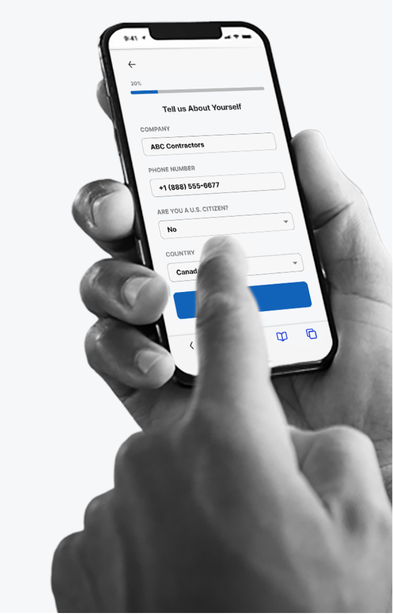
Contractors and visitors complete required videos, document sign-offs, and comprehension quizzes before arriving on site. The entry point becomes an enforcement checkpoint, confirming that training happened rather than delivering it. - Role-Specific Content
Role-specific training content. A contractor working in a restricted production zone receives different content than a vendor visiting the front office. Relevant, targeted training is more likely to be retained and applied, and more defensible during an audit than a generic orientation delivered to everyone equally. - Mobile-First Check-in for Logistics and Delivery.
QR-code-based workflows allow drivers to review and sign compliance documents from inside the truck, eliminating the queues, paper forms, and delays that make on-arrival training a logistical problem rather than a safety one.
When updated regulations require new training content, materials are uploaded once and immediately available across all sites: no reprinting, no version lag, no gap while updated content rolls out location by location.
Is This Gap in Your Facility?
3. The Multi-Site Consistency Problem


When each site interprets pre-entry requirements differently, enforcement varies by person and location. The organization may feel compliant while carrying liability it can't see. By the time an issue surfaces, it's often already a liability.
How Facilities Close This Gap
The problem is structural. When individual sites interpret pre-entry requirements differently, enforcement variation is built into the program. The gap lies in execution, not documentation, and it persists regardless of how clearly the policy is written.
Facilities that have closed this gap have moved away from policy-based standardization toward system-based standardization:
- Uniform Automated Workflows Across Every Site
The same process executes at every location, automatically, regardless of who is managing it locally. That removes the human interpretation layer that creates variation: a contractor who passes at one site meets the same requirements as a contractor who passes at another. - Cross-Site Compliance Visibility for Leadership
Real-time dashboards surface approval rates, expiration trends, and compliance gaps across all locations simultaneously, giving EHS leadership the same view an auditor would use before the audit arrives. The alternative is building that picture manually each time someone asks for it. - Single Documentation Repository Across Departments
When HR, safety, and operations are pulling from the same system rather than maintaining separate records, the reconciliation burden disappears, as does the fragmented picture it produces.
Is This Gap in Your Facility?
Case Study: Litehouse Inc.

Litehouse Inc. is a food manufacturer operating facilities across Idaho, Michigan, Utah, and Virginia, hosting over 1,000 visitors, contractors, and drivers each month. Their previous process relied on paper logs and spreadsheets spread across HR, safety, and operations, with no unified view of who was on site or whether compliance requirements had been met.
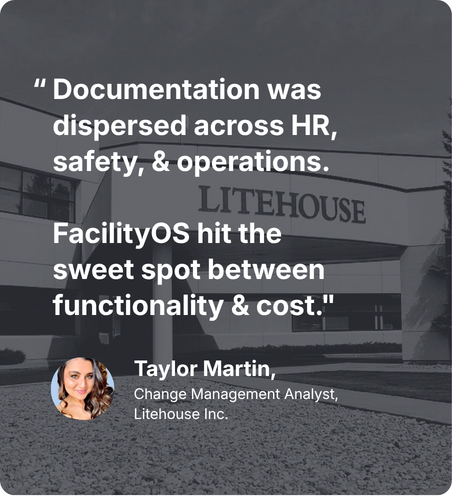
After deploying the visitor management solution VisitorOS, Litehouse replaced manual sign-ins with kiosk-based check-ins that handle visitors, contractors, and drivers in a single platform. Check-ins that previously took minutes now take seconds, and all records are centrally stored and instantly accessible for safety and HR teams.

Program Maturity: Side by Side
Most EHS programs at mature facilities have the fundamentals in place. Documented policies. Current training records. Employees who know the procedures. The gaps that create audit exposure, emergency failures, and repeat incidents rarely originate in policy. They originate in the systems, or absence of systems, behind the policy.
When People Arrive: The Processes That Make Standards Operational
Pre-arrival processes set the expectation. Arrival is where it either gets enforced or quietly waived, depending on how busy the facility is, which shift is running, and who happens to be at the desk.
For employees, arrival means check-in, badging, and in some facilities, health screening or safety briefings relevant to that day's work.
For visitors, it means registration, identity verification, and safety orientation.
For contractors, it means confirming that credentials are current, documentation is complete, and any site-specific requirements have been met before work begins.
What those processes include varies by industry. Healthcare, medtech, pharma, food and beverage, and some plastics and packaging manufacturers require hygiene checks, contamination screening, or health declarations before anyone enters production or patient-facing areas. Aerospace and defense facilities operating under ITAR must screen visitors against government watchlists and verify citizenship before granting access. Government contractors and secure facilities may require ID scanning and identity verification at the door. Construction sites often require signed safety documentation or site-specific training completion before work begins. In each case, these steps are part of regulatory compliance, not internal preference, and the arrival process is where they either get enforced or quietly skipped.
Taken together, these processes are where the standards established in planning and policy meet the reality of who is actually on site and whether they're qualified and prepared to be there.
The gaps that appear in arrival processes tend to follow consistent patterns: training compressed under operational pressure, credential checks based on outdated approvals, and access controls that don't reflect the actual requirements of each zone within the facility.
The sections below examine where those gaps most commonly occur, and what facilities with strong arrival processes do differently.
Arrival is where safety culture becomes operational. Every person who enters a facility (employee, visitor, or contractor) moves through a set of processes that either uphold the program's standards or quietly create gaps in them.
1. The Inconsistent Safety Training Gap
Safety training at arrival applies across every category of person entering a facility. Employees in new roles or returning after time away may need site-specific briefings. Visitors entering a manufacturing floor or lab environment need to understand the hazards relevant to where they're going. Contractors starting work need orientation to the specific risks of their assigned area before they begin.


In most facilities, that training still happens at the desk when someone arrives. A staff member walks the person through a safety video (often 30 to 40 minutes in construction and manufacturing environments), hands over a packet of documents to read and sign, and in some cases administers a quiz to confirm comprehension.
Every step depends on who is running it, how many people are arriving at once, and how recently the printed materials were updated. A contractor who arrives during a peak shift gets a compressed version. One who shows up when the safety coordinator is unavailable may receive a verbal summary instead. Paper sign-offs get filed somewhere, or they don't. None of it produces a consistent audit trail. When training content changes, every site requires reprinting, redistribution, and manual replacement of outdated materials.


How Facilities Close This Gap
Facilities with consistent arrival training have moved it out of the hands of whoever is staffing the desk and into a structured workflow that applies the same standard to every person, every time.
- Mandatory Completion Before Access is Granted
Digital systems require video completion, document acknowledgment, and comprehension quizzes before a badge is issued or access is enabled. Each step is logged with timestamps, creating a full audit trail that proves compliance was verified at arrival, not reconstructed after an incident. - Role and Destination-Based Training Configuration
A contractor working in a restricted production area, an employee returning from extended leave, and a visitor touring the facility each face different hazards. Configuring training content by role and access level means each person receives orientation relevant to where they're going and what they'll be doing, with documentation that reflects it. - Consistent Delivery Across Every Site and Every Shift
When regulations change or procedures are updated, revised materials are uploaded once and available immediately across all locations. No reprinting, no version lag, no window of exposure while updated content works its way through the distribution chain.
Is This Gap in Your Facility?
Case Study: Valmet

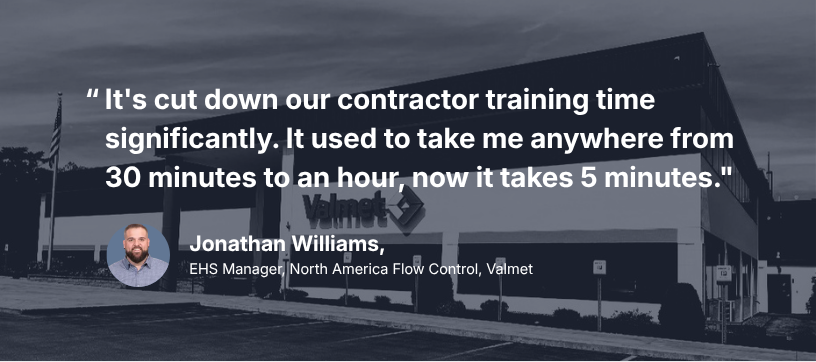 Valmet, a global leader in process technologies for the pulp, paper, and energy industries, operates over 40 locations in North America. Their facilities previously relied on a manual pen-and-paper system for visitor management and contractor training: a process that was slow, inconsistent, and difficult to audit.
After deploying the visitor management solution VisitorOS, Valmet integrated safety orientations directly into the check-in workflow via on-site kiosks. Contractors receive and acknowledge required safety information before entering the facility, every time, regardless of which site they're at.
The impact: a more than 90% reduction in contractor training time, with consistent delivery and automatic documentation across all North American sites.
2. The Access Enforcement Gap
Access enforcement at arrival is about more than knowing who came through the door. It's about confirming that the person arriving is who they say they are, that their credentials and qualifications are current, and that they're authorized to access the specific areas of the facility relevant to their visit or work.
60%+ of data breaches are linked to third-party vendors with weak compliance controls.
An expired security clearance or unverified background check can be the weak link that exposes the entire organization (source).
For contractors, that means verifying that certifications haven't lapsed since the last visit and that documentation on file reflects current compliance status, not an approval that was recorded weeks ago. For visitors in regulated environments, it means confirming that required health screenings, hygiene declarations, or background checks have been completed before access to sensitive areas is granted. For all categories, it means that access controls reflect the actual requirements of each area within the facility, not a single standard applied uniformly regardless of risk level.
For manufacturers with restricted production areas, government contractors operating under ITAR export controls, and food processors with hygiene and contamination protocols, who accesses what area is a direct safety and compliance risk. Manual enforcement of those distinctions, which depends on staff awareness and real-time judgment, creates inconsistency that compounds over time.
How Facilities Close This Gap
Reliable access enforcement at arrival requires removing the manual judgment layer and connecting credential status to access control in real time.
- Real-Time Credential verification at Check-in.
Contractors cannot check in if credentials are expired. Compliance status is verified at the point of entry, and access is denied automatically when requirements aren't met. The check happens at arrival, not during a periodic manual review that may be days or weeks away. - Role and Destination-Based Training Configuration
Screening integrated into the arrival workflow. Enterprise visitor management systems screen visitors against internal or external watchlists before access is granted, not after an incident prompts a retroactive review. In regulated industries, health declarations, hygiene confirmations, and required documentation can be built into the same workflow, ensuring nothing is skipped under operational pressure. - Consistent Delivery Across Every Site and Every Shift
Zone-based access control tied to qualifications. Not every person arriving at a facility requires access to every area. Connecting credential and qualification status to specific access zones means the system enforces those boundaries automatically. A contractor approved for general site access cannot enter a restricted production area, and a visitor cleared for the front office cannot access a warehouse floor, without a deliberate authorization decision being made.
Is This Gap in Your Facility?
Section Summary


Program Maturity: Side by Side
When Something Goes Wrong: Emergency Preparedness as a Core Safety Culture Discipline
Pre-arrival processes set the expectation. Arrival is where it either gets enforced or quietly waived, depending on how busy the facility is, which shift is running, and who happens to be at the desk. The gaps that surface during emergency events tend to fall into two categories:
Both categories matter.
A facility with strong processes but incomplete coverage will still leave people unaccounted for. A facility that covers everyone but relies on manual processes will still struggle to perform under pressure.
We examine where each type of gap tends to appear, and what facilities with mature emergency preparedness cultures are doing differently.
1. The Real-Time Visibility Gap
Real-time visibility is the foundation of an effective emergency response. Without an accurate, live picture of who is on site at the moment an event triggers, every decision that follows (who to communicate with, where to search, how to confirm accountability) starts from an incomplete position.
Manual evacuee tracking processes, like paper clipboards and walkie-talkies, create this problem across both employee and non-employee populations.
For employees, rosters go out of date between updates, hybrid schedules introduce uncertainty, and overlapping shifts mean headcount assumptions are often wrong before an event begins.
For visitors and contractors, 54% of facilities lack visibility into where they are during an emergency.
That gap exists not because of negligence, but because their presence is managed through separate systems that don't connect to the emergency response process.

How Facilities Close This Gap
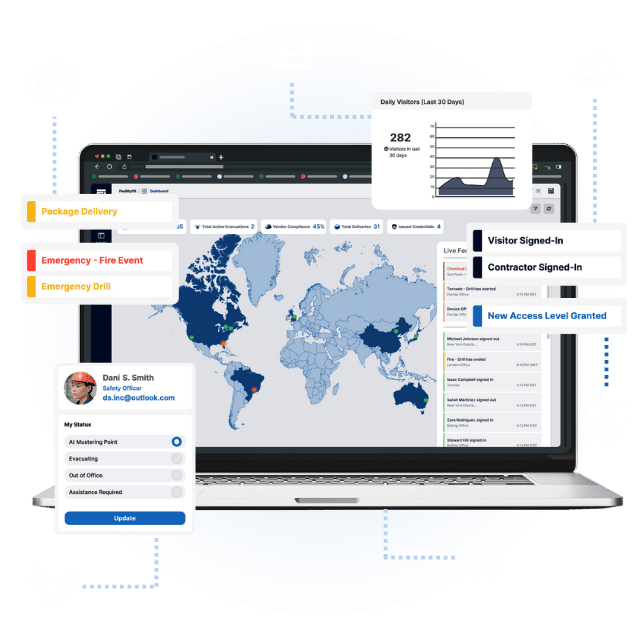
The fix is structural: a platform that integrates with your HR systems, employee sign-in data, and visitor management systems creates a single, continuously updated roster. When an event triggers, the on-site population is already known, not assembled from multiple disconnected sources under pressure.
- A Single, Live On-Site Roster Built From Integrated Systems
When your HR system and employee sign-in data (which together track who among your workforce is actually on site at any given moment) and your visitor management system (which tracks visitors and contractors at check-in) all feed into the same emergency management platform, the full on-site population (employees, visitors, and contractors) is included automatically the moment an event triggers. Safety officers have a live roster showing who is on site, who has evacuated, and who may still be at risk: employees, visitors, and contractors, without switching between systems or cross-referencing separate records. - Continuous Accuracy, Not Point-In-Time Snapshots
Because the roster draws from live check-in and HR data, it reflects arrivals and departures in real time. The headcount at the moment of an event is accurate to that moment, not to whenever someone last updated a spreadsheet or signed a log.
Is This Gap in Your Facility?
2. The Emergency Communication Gap
Effective emergency communication is a process discipline. It requires the right message to reach the right people immediately, and that process needs to work for every person on site, not just the employees in the communication tree.
When communication is slow or unclear, behavior defaults to habit over instruction. People head toward familiar routes regardless of posted maps, and emergency-only exits go unnoticed: research finds they're recognized at just 20% the rate of regular stairways. That pattern affects employees and visitors alike, with one key difference: employees have at least been through drills. Visitors and contractors often haven't.
Most facilities update emergency plans annually. Twenty-eight percent don't test or update them regularly at all. When the plan hasn't been reviewed since last year's drill, the communication process it describes may no longer reflect current facility layout, current staffing, or current operations.


How Facilities Close This Gap
Communication reliability under pressure requires removing the manual steps (contact list compilation, sequential notification, and secondhand instruction chains) that introduce delay when speed matters most.
- Instant Multi-Channel Notification For Everyone On Site.
The moment a threat is detected, contact details for employees, visitors, and contractors are pulled automatically and notifications go out via SMS, email, or app-based alerts with clear instructions. No manual compilation, no communication chains. - Two-Way Status Coordination
Mass notifications, muster point directions, and two-way status updates keep safety officers informed and evacuees coordinated, reducing the guesswork that delays evacuations and leaves people waiting for instructions that haven't arrived. - Scenario-Specific Messaging
A tornado requires shelter-in-place instructions. A fire requires evacuation routes. A hazmat incident requires zone-specific guidance. Pre-built scenario templates mean the right message goes out immediately, rather than being drafted under pressure by someone managing the event at the same time.
Is This Gap in Your Facility?
Case Study: Ingersoll Rand

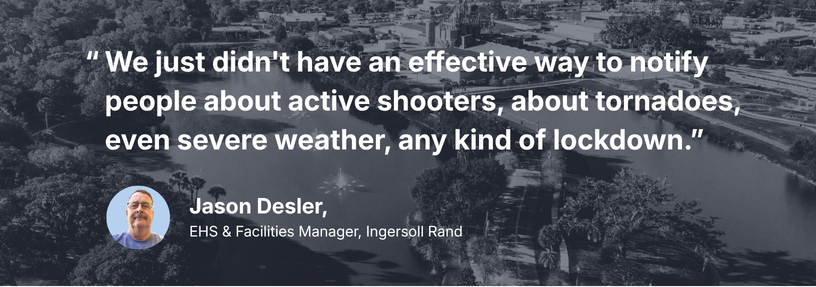 Ingersoll Rand's Ocala, Florida manufacturing plant, home to around 250 employees and regular daily visitors, had no reliable way to notify people on site during an emergency. The facility relied on an emergency phone line, PA announcements, and individually sent text messages. When organizational changes eliminated the emergency phone line, the gap became operational: severe weather was approaching and no coordinated notification process existed.
After deploying FacilityOS's emergency management solution, EmergencyOS, the gap closed quickly. When a tornado alert was issued shortly after implementation, Jason accessed the system, typed the emergency instructions, and sent them. Employees received the message by text and email in seconds, without a chain of individual calls or a PA announcement that may not have reached the full site population. The facility now meets evacuation and roll call benchmarks within seven minutes.
The same platform also replaced the lobby's phone-and-paper visitor check-in with a digital kiosk handling ID verification, badge printing, and entry logging, giving safety personnel an accurate picture of who is on site before any emergency begins.
Read More
3. The Mustering & Headcount Gap
OSHA requires employers to account for every person after an evacuation. Manual clipboard headcounts remain the standard practice, and they routinely produce incomplete results. The process is slow, records are difficult to verify in real time, and there is no reliable way to confirm that every person who was on site made it out until the clipboards come back and someone compiles the results.
For employees, the risks are real even when the roster appears current. Overlapping shifts, late arrivals, and early departures mean headcount assumptions at the moment of an event are often wrong before anyone picks up a clipboard. An employee who stepped outside, moved to a different building, or was working in an area not covered by their assigned muster zone may not surface as missing until the process has already stalled. If the person responsible for a zone is unavailable, or the list they're working from isn't accurate, accountability comes down to memory and improvisation.
That gap compounds further when visitors and contractors aren't integrated into the same process. Their accountability depends entirely on a secondary manual check that may not happen at all under pressure.


How Facilities Close This Gap
Digital mustering replaces the clipboard with a process that updates in real time and doesn't depend on someone physically collecting and reconciling paper lists.
- Live Status Updates at Muster Points
Employees, visitors, and contractors update their status via mobile app or SMS upon reaching their muster point. Headcounts update instantly, and safety officers see who is accounted for and who isn't, in real time, without waiting for clipboards to return from across the facility. - Automatic Audit Trail
Digital mustering generates a timestamped record proving emergency procedures were followed, which supports OSHA and ISO compliance reviews and post-incident analysis beyond what a paper headcount can support. - Accessibility Planned in Advance, Not Retrofitted
Inclusive evacuation equipment, trained support staff, and accessible routes should be part of the standard plan from the start. When mobility devices are strategically placed and staff are trained in their use, the organization can protect everyone equitably, avoiding the scenario where an incident reveals that the plan didn't account for a significant share of the on-site population.
Is This Gap in Your Facility?
4. The Static, Untested Emergency Plan
In a recent article, the team at EHS Leaders called out that training reduces pre-evacuation delay by nearly 1.5 minutes (NIST): a finding with real consequences in a live event.
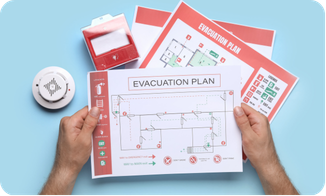
A safety program that treats emergency planning as an annual compliance task will produce plans that drift out of alignment with how the facility actually operates. New equipment, layout changes, and updated shift schedules can each create a mismatch between what the plan assumes and what is actually true on the ground. The plan passes the annual review, and the gap goes undetected until something exposes it.
Manual drills compound this problem. When exercises are run with clipboards and manual observation, the data they produce is limited to attendance: who showed up, who signed the sheet, and whether the drill was completed. Evacuation times, communication delays, accountability gaps by zone, and bottlenecks in the response process go unrecorded.
Without that structured performance data, the same bottlenecks repeat across every drill, and there is no evidence-based path to improving over time. A drill confirms participation. It doesn't confirm readiness.

How Facilities Close This Gap
Treating each drill as a data source rather than a compliance event transforms emergency preparedness from a static program into a system that improves over time.
- Performance Tracking Across Every Drill
Digital drill systems capture evacuation times, participation rates, notification speed, and return-to-operations time across all roles and locations. Each exercise produces data that identifies where the process broke down and where it performed well. - Baseline and Trend Analysis
Facilities that track drill performance over time can identify consistent bottlenecks, compare performance across sites, and target training where it will have the most impact. Improvement becomes measurable rather than assumed. - Scenario-Specific Plan Design
A tornado scenario requires shelter-in-place procedures. A flood requires power backup and elevated storage protocols. Generic plans applied to every event type create response gaps that only become visible when the specific conditions they weren't designed for actually occur.
Is This Gap in Your Facility?
Section Summary

Program Maturity: Side by Side
Read More
After the Fact: Turning Incidents and Audits Into Improvement
The quality of a safety program is visible not just in how well a facility prevents incidents, but in what it does after they occur. Investigations, corrective actions, audit findings, and drill performance data are the inputs that separate a safety culture that improves over time from one that documents the same problems year after year.
What makes post-incident and post-audit processes effective is the same thing that makes the pre-arrival and arrival processes effective: complete, accurate, accessible data. Every process covered in the previous sections generates records that auditors will ask for. Pre-arrival credential verification and training completions. Visitor and contractor check-in logs, including hygiene declarations, watchlist screening results, citizenship verifications, and safety orientation sign-offs. Emergency response records showing who was on site, how communication was handled, and whether accountability was confirmed. Drill performance data documenting evacuation times, participation rates, and identified bottlenecks. When those records are fragmented across departments and systems, when corrective actions are tracked manually through email and spreadsheets, when incident reports exclude whole categories of people who were on site, the picture that emerges is partial. Corrective actions address what the data shows. The gaps the data doesn't show repeat.
The three gaps below reflect where post-incident and post-audit processes most commonly break down, and where facilities with mature safety cultures have built the infrastructure to close them.
1. The Fragmented Records Problem

The practical consequences are measurable. 57% of EHS professionals struggle to identify compliance gaps, and 52% face difficulty conducting thorough risk assessments. These are data access problems as much as resource problems. When the information needed to see a gap isn't consolidated in one place, the gap goes unmanaged.
Auditors evaluate proof, not effort. A safety program that produced strong results but documented them poorly looks weaker during an inspection than one with consistent, accessible records, regardless of what actually happened on the ground.

How Facilities Close This Gap
Centralizing compliance data removes the reconciliation burden and transforms audit preparation from a reconstruction exercise into a confirmation one.
- A Single Record of Truth Across All Compliance Categories
Every record generated by the processes in this guide — credential verifications, check-in logs, training completions, emergency response data, drill outcomes — lives in one system, consistently formatted and accessible on demand. OSHA, food safety regulations, and ITAR each require specific documentation from those processes. Whether a facility can produce it in an audit comes down to where and how it was captured. - Consistent Templates and Formats Across All Sites
Variation in how records are structured across locations gives auditors evidence of a program that isn't controlled, even when the underlying work was done correctly. Standardized formats across sites remove that variation and demonstrate that the program operates consistently, not site-by-site. - Reporting That Takes Minutes, Not Days
When records are centralized and structured, compliance reports can be generated on demand, not assembled manually in the days before an audit while the team simultaneously manages ongoing operations.
Is This Gap in Your Facility?
Case Study: SMTC Corporation

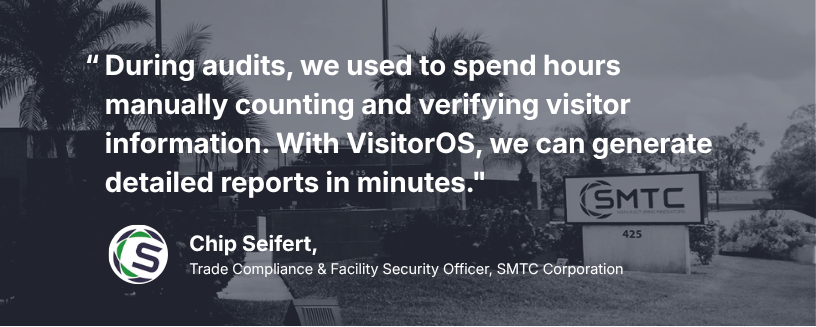 SMTC Corporation is a contract electronics manufacturer subject to ITAR regulations, which require visitor screening against the U.S. State Department's Consolidated Screening List before facility access is granted. Their previous process had no pre-registration or automated screening capability. Records were collected on paper, cross-checked manually, and compiled into reports only when an audit required it, which meant documentation gaps only became visible under scrutiny, when it was already too late to address them cleanly.
After centralizing visitor management and integrating watchlist screening at check-in, SMTC standardized the process across facilities. Records were created at the point of entry, consistently formatted, and accessible without manual reconstruction.
The practical outcome was audit preparation that confirmed compliance rather than attempted to reconstruct it.
2. The Corrective Action Gap
Identifying a gap is only part of the work. The corrective action that follows has to close on time, with clear ownership, and with documentation that proves it was addressed. When those actions are tracked through email threads and shared spreadsheets with no system-enforced ownership or deadlines, they tend to age quietly: deadlines pass, ownership diffuses, and the same finding reappears in the next audit because the action was never verified as complete.
Open corrective actions are among the first things auditors look for, and among the clearest signals that a safety program's post-incident process isn't functioning as a closed loop.

How Facilities Close This Gap
The corrective action process works when accountability is built into the system rather than dependent on individual follow-through. Some software tools, including contractor compliance management systems, include built-in task management that enables this automatically: triggering actions, assigning owners, and tracking closure without a separate workflow tool.
- Assigned Ownership With Tracked Deadlines
Each corrective action has a designated owner and a due date recorded in the system. Dashboards surface completion rates, open actions, and overdue items, giving EHS leaders the same view an auditor will use before the audit. Nothing ages invisibly. - Automated Escalation For Overdue Items
When a corrective action passes its deadline without closure, the system flags it and notifies the relevant owner and supervisor. The follow-up process happens automatically rather than depending on someone remembering to check a spreadsheet. - Verifiable Closure, Not Self-Reported Completion
Closing a corrective action in the system requires documentation that the action was taken, not just a status change. That creates an evidence trail auditors can review and that the safety team can reference if the same issue recurs.
Is This Gap in Your Facility?
3. The Incomplete Post-Incident Picture

Post-incident analysis is only as useful as the data it draws from. Incident reports that exclude whole categories of personnel (whether because visitor and contractor records were managed in a separate system, or because employee sign-in data was not integrated into the response process) produce an incomplete picture of what actually happened. Corrective actions built on that picture address only what the data captured. What it missed repeats.
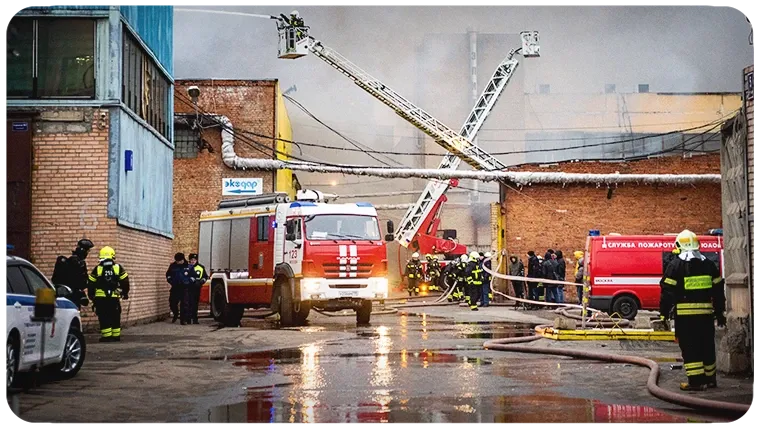
But the incomplete picture problem extends beyond missing personnel records. When compliance data is fragmented across systems, EHS professionals spend significant time compiling and reconciling records rather than analyzing them. The result is a program that can document activity but struggles to identify trends, quantify outcomes, or connect safety performance to business impact. Without that capacity, patterns go unrecognized across cycles, and the case for investing in stronger infrastructure is difficult to make to leadership.
How Facilities Close This Gap
Closing the post-incident picture gap requires both complete data and the organizational capacity to act on it.
- Analytics That Cover the Full On-Site Population
When incident and drill data includes employees, visitors, and contractors in a single system, patterns emerge that partial data sets miss: repeated bottlenecks, areas of consistent underperformance, response gaps that only appear when the complete picture is visible. Improvement plans built from that data close the actual gap, not just the portion that was documented. - ROI Metrics That Translate Safety Outcomes Into Business Language.
DART rates (Days Away, Restricted, or Transferred, an OSHA metric that measures workplace incidents serious enough to result in time away from work, restricted duties, or a job transfer), workers' compensation costs, and training participation trends are the metrics that connect safety culture to operational and financial performance. When EHS leaders can quantify what the program is producing, the conversation with leadership shifts from cost center to investment, and resources follow accordingly. - Administrative Burden Reduction That Frees Capacity for Analysis
"The first place to start in using technology more efficiently for EHS is to look at ways to remove administrative tasks. That's a big time saver for EHS professionals." When the time spent compiling records and chasing documentation is reduced, EHS professionals can focus on what the data actually reveals and on the decisions it should inform.
Is This Gap in Your Facility?
Section Summary




Program Maturity: Side by Side
Conclusion
A safety program can have strong policies, current training records, and documented procedures, and still have structural gaps that only become visible during an audit finding, a near-miss, or a real emergency. The gap between a program that looks complete and one that performs under pressure is rarely a policy problem. It's an infrastructure problem.
The four areas this guide examined (what happens before people arrive, when they arrive, when something goes wrong, and after the fact) are the points where that infrastructure either supports the program or undermines it. Each stage depends on processes that are consistent, enforced, and connected. When those processes rely on manual execution, fragmented systems, and human judgment under pressure, outcomes vary by site, by shift, and by whoever is at the desk. When they're built into systems that enforce standards automatically and capture complete data, the program holds regardless of who is managing it on a given day.
Facilities that pass audits with confidence, respond to emergencies without improvising, and demonstrate consistent performance across sites share one characteristic: the infrastructure behind their safety program is as strong as the program itself.
Tech Recommendations
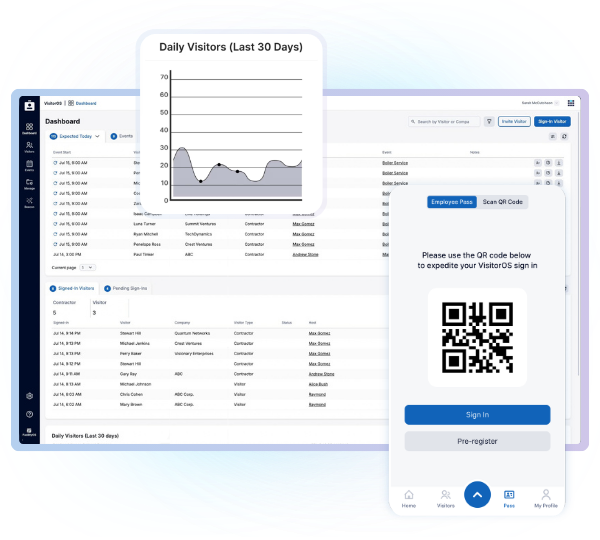
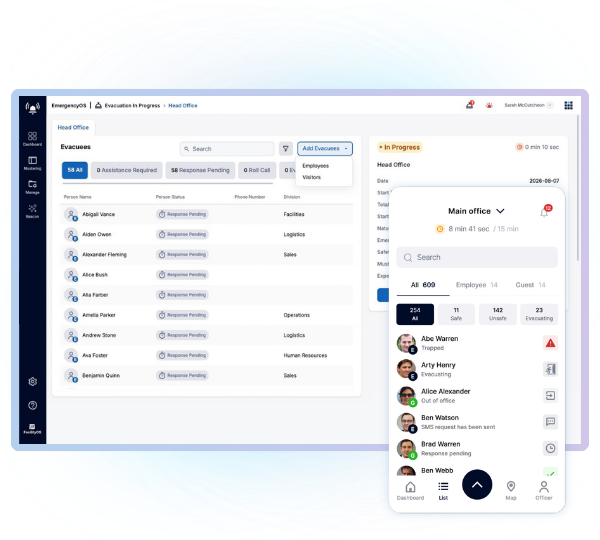
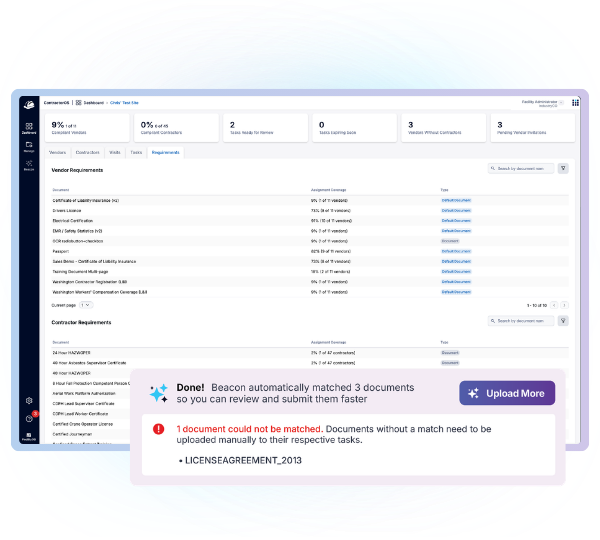
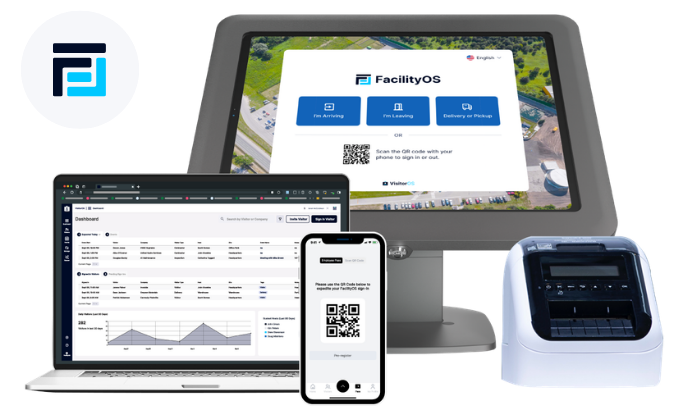
Every gap examined in this guide has a structural solution. The sections above describe what those solutions look like in practice. FacilityOS provides the platform that makes them operational, connecting pre-arrival, arrival, emergency, and post-incident processes into a unified system that covers every category of person on site.
VisitorOS: Visitor Management
EmergencyOS: Emergency Management & Preparedness
ContractorOS: Contractor Compliance Management
The FacilityOS Platform: Connected Across Every Stage

Build A Safety Culture With Robust Infrastructure
Get the full playbook on safety culture, compliance, and the infrastructure behind it. Includes practical gap assessment score card, best practices, success stories, industry insights and data, and a recommendations for tools to enhance your EHS safety program.
Download PDF Version



See How FacilityOS Closes the Gaps
Want to see how one connected platform closes these gaps for every employee, visitor, and contractor on site?