
🔑
Key takeaway: The biggest daily challenge in most mailroom operations isn't delivery speed or package volume, it's documentation. Survey data from 150 facility and mailroom operations leaders shows that 42% cite audit, compliance, or chain of custody tracking as their top daily pressure point. That finding has direct implications for how mailroom capacity is measured, resourced, and supported.
Survey data from 150 facility management and mailroom operations leaders across varies industries, such as healthcare and education, shows that managing exceptions, audits, compliance requirements, and chain of custody tracking now outranks every other operational challenge as the primary source of daily friction. More respondents identified administrative accountability as their biggest problem than cited package volume, delivery accuracy, or sorting speed combined.
The gap this data reveals is between what mailrooms are expected to prove and what their current processes are built to produce.
What Takes Up the Most Time in a Mailroom?
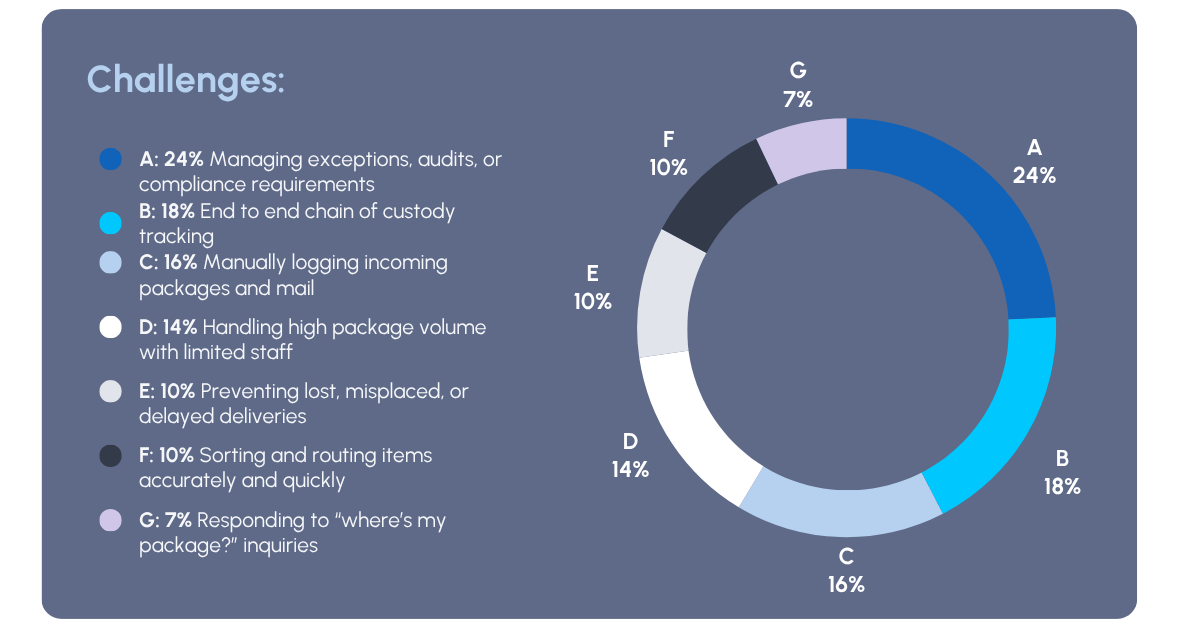
When 150 facility management and mailroom operations leaders were asked to identify their single biggest day-to-day challenge, the results were consistent. Managing exceptions, audits, or compliance requirements ranked first at 24%. End-to-end chain of custody tracking ranked second at 18%.
Together, those two categories account for the 42% figure referenced throughout this article, representing the combined share of respondents whose top daily pressure point is audit, compliance, or chain of custody tracking.
Manually logging incoming packages ranked third at 16%. Handling high package volume with limited staff came in at 14%. Preventing lost, misplaced, or delayed deliveries was cited by 10% of respondents, sorting and routing accuracy by another 10%, and responding to "where's my package?" inquiries by 7%.
Combined, 58% of reported daily challenges relate to record-keeping, compliance, and tracking (the top three categories), not the physical movement of packages. Speed and accuracy, often assumed to be the primary operational concerns, ranked well below documentation and accountability.
That distribution reflects a shift in where operational pressure is concentrated. Physical throughput still matters, but it accounts for a smaller share of daily friction than the administrative work surrounding it.
Why Mailroom Documentation Pressure Has Increased
The structural driver is volume. An estimated 23.4 billion parcels were shipped in the United States in 2025, a figure representing sustained multi-year growth driven by e-commerce and the normalization of workplace package delivery. Facilities designed and staffed for a lower-volume environment are now processing significantly more packages per day, across more carriers, with shorter delivery windows.
Documentation processes, in many cases, were designed for a fraction of that volume. Handwritten logs, spreadsheet entries, and verbal confirmations work when volume is predictable and disputes are rare. They become harder to sustain when volume increases and accountability expectations rise alongside it.
Those accountability expectations are worth examining directly. Once a carrier marks a package as delivered, responsibility transfers to the facility. From that point, the operation is responsible for demonstrating who accepted the item, when custody changed hands between staff members, and where responsibility moved at each subsequent step through to final pickup. That is a detailed evidentiary standard, and it applies whether a dispute arises or not.
The Difference Between Logging a Package & Proving What Happened to It
Writing down that a package arrived documents that an event occurred, but it does not, on its own, create proof of custody.
Defensible documentation, the kind that can resolve a delivery dispute, satisfy an auditor, or protect a team from liability, requires a continuous chain of time-stamped custody events, each capturing who had the item and when responsibility transferred, from dock to recipient.
Most manual systems produce event records. Most accountability standards now call for continuous proof.
When records can't answer custody questions cleanly, those questions generate investigation work. The average missing package investigation at 45 to 90 minutes of staff time per incident, often distributed across multiple follow-ups rather than resolved in one pass. During periods of high volume, investigations frequently exceed an hour.
In facilities where delivery disputes arise weekly or daily, that investigation time accumulates into a measurable labor cost. The same documentation gaps that generate investigations also tend to make them longer, because the records aren't structured to surface fast answers.
Where Chain of Custody Gaps Tend to Appear
Documentation gaps are usually structural rather than the result of individual error. They tend to be built into how manual intake systems function under real operating conditions.
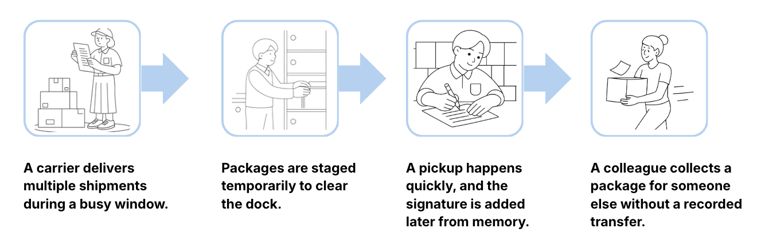
Consider a common sequence that plays out in high-volume mailrooms:
-
A carrier delivers multiple shipments during a busy window.
The dock is full, staff are already processing earlier arrivals, and there's no time to log each package individually as it comes off the truck. Intake records get created after the fact, with approximate timestamps filled in from memory. That lag is where the first gap in the chain tends to appear. -
Packages are staged temporarily to clear the dock.
Items are moved to a holding area so the next round of deliveries can be received. This internal move rarely gets documented as a custody event, even though the package has physically changed location and may have changed hands. -
A pickup happens quickly, and the signature is added later from memory.
The recipient grabs their package in passing, or a staff member hands it off during a rush. The signature line gets filled in after the fact, sometimes by someone who wasn't present for the handoff. Handwritten signatures are frequently illegible, and most manual systems have no mechanism for verifying that the person who signed was the intended recipient or an authorized proxy. -
A colleague collects a package for someone else without a recorded transfer.
A team member picks up a delivery on behalf of a coworker. A department office accepts an item for someone who's out. Each transfer feels routine, but each one is also a handoff with no documentation. By the time a question arises, there is nothing in the record to reference.
In multi-shift and multi-building operations, this sequence plays out across even more handoffs. Packages move between buildings, get handed off at shift changes, and travel internal delivery routes, each step adding another undocumented transfer. If a package is eventually reported missing, there may be several points where custody could have changed, with no way to isolate which one.
These are normal operating conditions in high-volume mailrooms. More than 52% of mailrooms still rely primarily on manual workflows such as paper logs and spreadsheets, which makes these gaps a sector-wide pattern rather than an isolated problem.

What Facilities With Complete Chain of Custody Records Do Differently
The operations that have eliminated lost package investigations share one characteristic: proof is created as part of the work, not assembled after it.
An American University had implemented real-time tracking and digital chain-of-custody records across campus mail and logistics operations serving more than 38,000 students, 21,000 staff, and 2,500 faculty. Since implementation, the university has reported zero lost packages over more than 17 years, with 100% accountability across campus. Every package movement is logged digitally at the moment it occurs, creating a complete and searchable custody record without any need for after-the-fact reconstruction.
Jones Lang LeSalle (JLL), which manages approximately 146,000 packages per year across corporate real estate environments, resolved a $1 million delivery dispute by producing time-stamped digital records showing exactly where custody changed hands. The records allowed the mailroom team to be cleared quickly. The outcome came down to the records existing in a form that could answer the question immediately.
Both outcomes followed the same structural shift: moving from documentation that captures events to systems that create proof at the moment events occur.
How to Assess Whether Your Current Process Creates Actual Proof
For facility and mailroom managers evaluating their own operations, the relevant question is not whether records exist. Most operations have records. The question is whether those records can answer accountability questions under pressure, during a dispute, an audit, or an investigation that reaches leadership or security.
A few diagnostic questions are worth considering:
Can the full custody chain for any package within the last 90 days be reconstructed in under five minutes? If the answer involves checking multiple sources, contacting colleagues across shifts, or reviewing physical logs, the records may not be structured to support on-demand accountability.
Do intake records capture exact timestamps, or approximations? Approximate timestamps can create credibility problems when they conflict with carrier GPS data. A record showing delivery "in the afternoon" carries less weight than a carrier log showing 2:17 PM.
Can the person who signed for a package be verified, along with their authorization to receive it? Illegible signatures and unverified pickups are two of the most consistent reasons investigations stall.
Are shift transfers and internal deliveries documented as custody events? If packages move between staff members without a recorded handoff, the chain of custody has a gap regardless of what the intake record says.
Operations with few documentation gaps tend to resolve incidents in under 30 minutes. Operations with significant gaps, particularly around timestamps, identity verification, and internal handoffs, typically spend 60 to 90 or more minutes per incident.
FAQs: Mailroom Chain of Custody & Daily Operations
Stop Losing Time to Investigations You Shouldn't Have to Run
LogisticsOS was built to close the accountability gap that manual systems create. Every package scan creates an automatic, time-stamped custody record. Every handoff is documented. Every notification is logged as proof. When a question arises, the answer is in the system, not in a stack of logs or a series of follow-up emails.
Stay updated with industry insights, success stories, and more. Follow us on social media for the latest FacilityOS content.
 Follow us on Facebook
  Follow us on X
 Follow us on LinkedIn