
If you walked into the lobby of a high-security manufacturing plant or a busy corporate campus today and asked, "Who is responsible for knowing exactly who is on-site right now?" you might get three different answers.
The Facilities Manager might point to the front desk reception team.
The Security Director might point to the access control logs.
The EHS Manager might point to the contractor induction records.
In many organizations, everyone assumes someone else has the full picture. The reality is often that no one has the full picture.
This is the "accountability gap." It is not a failure of any single individual; it is a structural issue. Visitor management touches operations, safety, and security, yet it rarely has a single owner, and when responsibilities are siloed, visibility fragments.
Understanding visitor management accountability requires looking at how these three distinct roles—Facilities, EHS, and Security—interact with visitor data, where the handoffs break down, and why a shared approach is critical for reducing risk.
The Facilities Manager: Operational Continuity
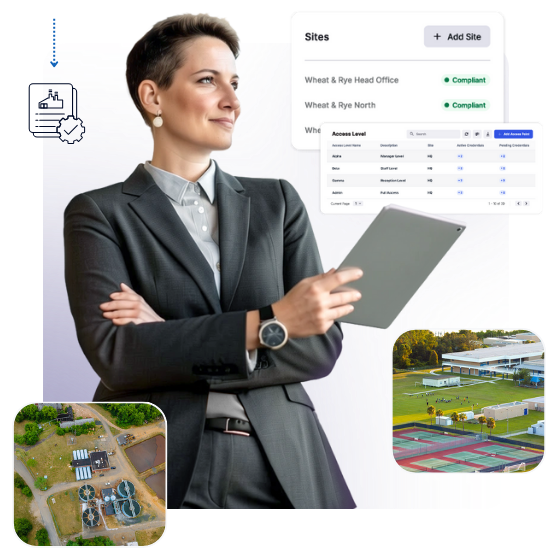 For the Facilities Manager (FM), the primary concern is the smooth operation of the building. Their goal is to ensure that legitimate visitors—contractors, vendors, and partners—can enter the site and do their work without friction.
From an FM perspective, knowing who is on-site is about resource management and maintenance flow.
- "Did the HVAC technician arrive on time?"
- "Is the cleaning crew still in the building?"
- "Who is occupying Conference Room B?"
The challenge for FMs is that they often inherit manual processes. If the visitor log is a paper binder at the front desk, the FM has no real-time data. They rely on phone calls or visual checks to confirm attendance.
Where the Gap Forms:
FMs often view visitor management as a logistical task—getting people in the door. They may not prioritize the deep background screening or safety compliance data that other departments need. If the process stops at "they have a badge," the FM’s visibility is limited to entry, not activity or compliance.
The EHS Manager: Safety and Compliance
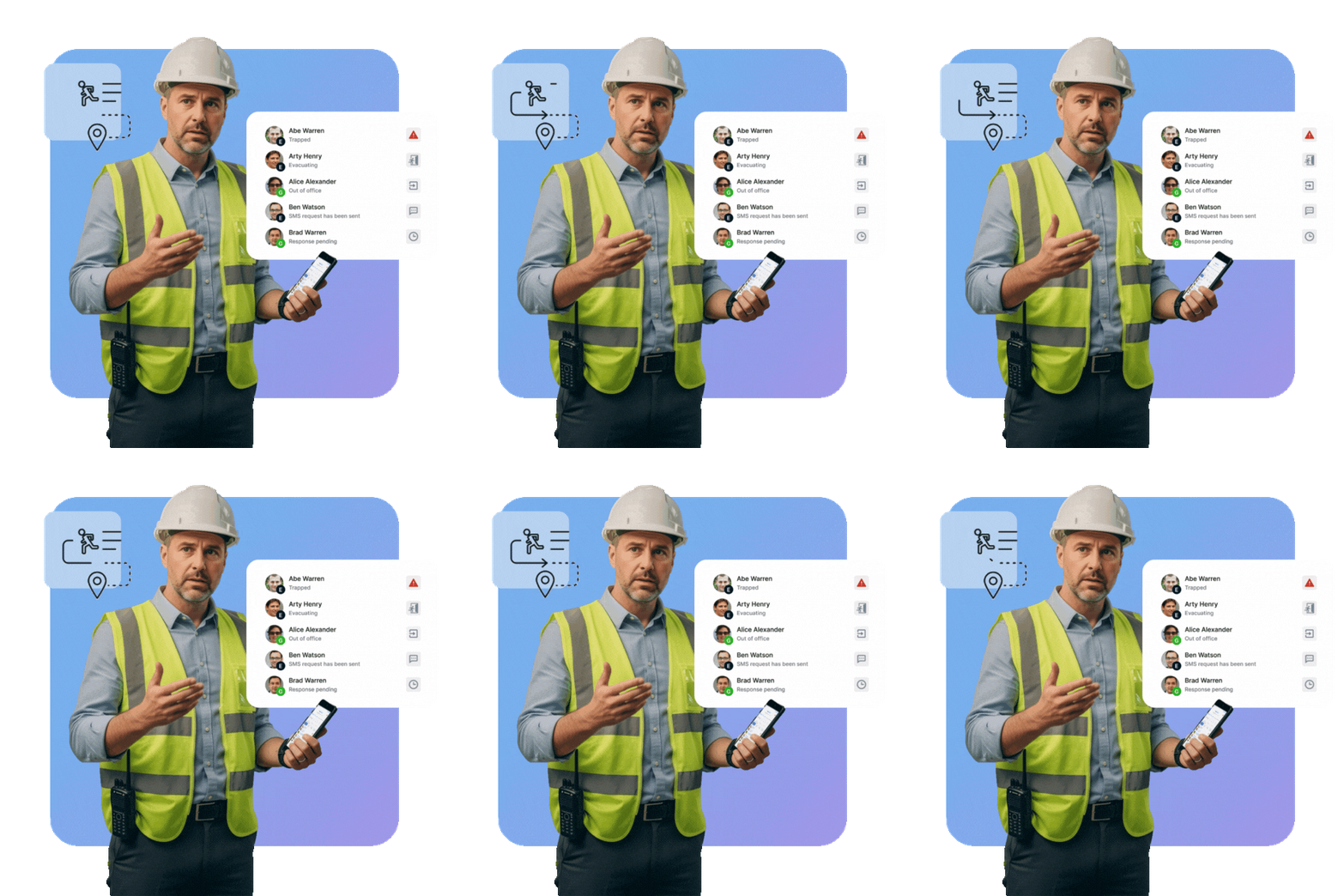 For the Environmental, Health, and Safety (EHS) Manager, a visitor isn't just a guest; they are a liability.
EHS is responsible for ensuring that everyone on-site—especially contractors performing high-risk work—is qualified, trained, and accounted for. Their lens on visitor management responsibility is strictly focused on compliance and emergency preparedness.
- "Did this contractor sign the updated safety waiver?"
- "Does this vendor have valid liability insurance?"
- "If we evacuate right now, do we know exactly how many non-employees are in the facility?"
Where the Gap Forms:
EHS managers often keep their own records. They might have a separate "Contractor Safety" binder or a digital portal for inductions that doesn't talk to the front desk system.
This creates a dangerous blind spot. A contractor might check in at the lobby (visible to FM) but skip the safety briefing (invisible to EHS). In an emergency evacuation, the EHS team might be counting heads based on a list that doesn't match the actual number of people in the building.
The Security Leader: Risk and Perimeter Control
 For the Security Leader, visitor management is the first line of defense. Their priority is on-site visibility for the purpose of risk mitigation.
Security cares about screening. They need to know if a visitor is on a watchlist, a former employee who was terminated, or a foreign national requiring an escort under export control regulations.
- "Is this person authorized to be here?"
- "Where are they allowed to go?"
- "When did they leave?"
Where the Gap Forms:
Security teams often operate the Access Control System (ACS), which manages badged employees well but handles temporary visitors poorly. Visitors might be issued a generic "Guest" badge that doesn't track their specific identity.
If Security relies solely on the ACS, they miss the context. They see "Visitor Badge 04 accessed Door 3," but they don't know *who* holds Badge 04 or if their safety induction is expired.
Risks of Shared Responsibility without Complete Visibility
The problem with visitor management accountability is that when everyone owns a piece of the puzzle, no one sees the full picture.
In a typical scenario:
-
FM invites a vendor to fix a machine.
-
Security clears them at the gate but doesn't check their safety certs.
-
EHS assumes the vendor is compliant because they were let in.
If an accident occurs, the finger-pointing begins. Who was supposed to verify the insurance? Who was supposed to track their exit time?
These gaps become critical during:
- Audits: When a regulator asks for proof of who accessed a secure area six months ago.
- Incidents: When a theft occurs and no one knows exactly which contractors were in the wing.
- Emergencies: When a fire alarm pulls, and the muster list is missing three visitors who didn't sign out.

Moving Toward Centralized Visibility
Solving this requires a shift in mindset. Organizations must stop viewing visitor management as a "front desk task" and start viewing it as a cross-functional data stream.
True visitor tracking compliance requires a system where data flows between departments.
- Facilities schedules the visit.
- Security sets the screening rules.
- EHS defines the safety requirements.
All three stakeholders need access to a "Single Source of Truth." When a visitor checks in, the system should verify safety documents (for EHS), check watchlists (for Security), and notify the host (for FM) simultaneously.
This doesn't mean one person does all the work. It means the process is unified.
Conclusion: Closing the Loop
So, who is responsible for knowing who is on-site?
The answer is: The Organization.
While specific tasks are delegated—Security handles the watchlists, EHS handles the waivers—the accountability for visibility must be shared.
When Facilities, Security, and EHS align on a single strategy, the gaps disappear. You move from fragmented spreadsheets and binders to a real-time view of your facility. You gain the ability to answer "Who is here?" instantly, accurately, and with full confidence.
By centralizing your data, you can streamline operations, enforce safety protocols, and ensure that no matter who asks, you always have the answer.
Stay updated with industry insights, success stories, and more. Follow us on social media for the latest FacilityOS content.
 Follow us on Facebook
  Follow us on X
 Follow us on LinkedIn