
Good Manufacturing Practice (GMP) is a quality assurance framework enforced by regulatory bodies including the U.S. Food and Drug Administration that governs how food, pharmaceutical, and medical device manufacturers design, operate, and document their production processes. For facilities subject to GMP, compliance is a condition of operating in regulated markets. Visitor and contractor access is one of the most documentation-intensive and frequently overlooked parts of meeting those requirements.
What Is GMP?
GMP (Good Manufacturing Practice) is a set of quality assurance standards that cover the full scope of manufacturing operations: raw material control, equipment validation, personnel training, environmental monitoring, quality testing, and documentation.
The regulations exist to ensure that products are consistently manufactured and controlled to the quality standards appropriate for their intended use. For pharmaceutical manufacturers, that means products are safe, effective, and accurately labeled. For food manufacturers, it means products are free from contamination and safe for consumption. For medical device companies, it means devices perform as intended under defined conditions.
In the United States, the FDA enforces Current Good Manufacturing Practices (cGMP) regulations under 21 CFR Parts 110, 210, and 211, among others. These standards align broadly with international frameworks including ISO 22716, EU GMP Directives, and WHO guidelines.
💡 GMP vs. cGMP: What's the Difference?
The terms GMP (Good Manufacturing Practice) and cGMP (current Good Manufacturing Practice) are often used interchangeably, but the distinction matters. The "c" in cGMP reflects the FDA's expectation that manufacturers use technologies and systems that are current, not simply those that were adequate when the original standards were written.
In practice, cGMP is the standard the FDA enforces in the United States today. It requires manufacturers to adopt up-to-date methods for production, quality control, and documentation, rather than relying on approaches that may have met the standard in the past but no longer reflect available best practices. International frameworks such as EU GMP and WHO GMP carry a similar expectation.
For most regulated facilities, the operative question is whether current systems, including visitor and contractor management, meet the documentation and control requirements the FDA would expect to see today.
Who Does GMP Apply To?
GMP requirements apply to manufacturers across pharmaceuticals, biological products, medical devices, food and beverage, dietary supplements, and veterinary products. The obligations extend beyond the production floor. Quality management systems, documentation controls, personnel practices, and facility access are all within scope.
That scope matters for visitor management. Anyone who enters a GMP-regulated production area, whether they work there permanently or not, is subject to the access and documentation requirements the regulation imposes. That includes contractors, auditors, equipment technicians, supplier representatives, and any other individual who arrives on-site.
Where GMP/cGMP Meets Visitor Management
GMP is primarily discussed as a manufacturing quality standard, but the part that creates the most daily operational complexity is documentation and access control for everyone who enters a controlled environment.
Every person who enters a GMP-regulated area is a potential source of contamination, documentation risk, or compliance exposure. Regulatory bodies expect that access to controlled areas is restricted to authorized individuals, that anyone who enters has completed required training, and that their presence is fully documented. That expectation applies to permanent staff and equally to every visitor, contractor, and temporary worker who arrives on-site.
A GMP facility's visitor access program should produce the same quality of documentation as any other part of its compliance system, because regulators treat it the same way.
The practical consequence is that a regulatory inspection can request records about any visit to a controlled area during a defined period. Research indicates that 91% of companies face operational issues tied to data quality problems, and nearly half of employees describe their company's filing system as ineffective or disorganized. In a compliance context, those gaps become audit findings.
GMP Requirements for Visitor Access
GMP regulations establish clear expectations for how visitors and contractors are managed in a regulated facility:
Induction training. Visitors and contractors must complete facility-specific training on GMP practices, hygiene requirements, and gowning protocols before accessing production areas. Completion must be documented and retrievable.
Hygiene and screening compliance. Facilities must screen individuals for compliance with hygiene standards applicable to the area they are accessing. Individuals who do not meet those standards are not permitted to enter controlled zones.
Access restriction. Visitors should only access areas directly relevant to their approved purpose of visit. Production lines, cleanrooms, controlled warehouses, and other GMP-regulated zones require documented authorization before entry is granted.
Legal acknowledgments. Visitors and contractors are typically required to sign GMP agreements, non-disclosure agreements, or facility-specific documents before gaining entry. These records must be stored and linked to the individual visit record.
Record-keeping. Every visit must be logged with sufficient detail to reconstruct what occurred: who visited, when they arrived and departed, what areas they accessed, what training they completed, and what documents they signed. These records must be maintained and available during regulatory inspections.
Visitor Program Maturity & GMP Compliance

How well a facility's visitor management program holds up under GMP/cGMP depends on how consistently it can enforce and document each of those requirements. A facility using paper sign-in sheets and a facility using a purpose-built visitor management system are both managing visitors. Only one of them can produce the records a GMP auditor expects to see.
Manual and Paper-Based Programs
At the lowest maturity level, facilities manage visitors with sign-in sheets, paper logbooks, generic badges, and manual briefings at the front desk. This captures basic information but leaves significant gaps when measured against GMP requirements.
Those gaps accumulate quickly in practice. Induction training completion depends on whoever is staffing reception. GMP agreements are signed on paper but not linked to a specific visit record in any retrievable way. Access to controlled areas is managed by physical escorts who get pulled away or make judgment calls. Different departments apply different standards depending on who is on shift.
Contractor access is where these programs carry the most exposure. Poorly managed contractor and temporary access in regulated environments tends to produce four specific failure modes: standing privileges where credentials stay active after a visit ends, over-privileged access that gives contractors broader zone access than their work requires, poor log traceability where records show what someone could access rather than what they actually did, and visitor workflows that do not produce the documentation standard regulators expect.
Producing documentation during an audit typically means locating physical records across multiple systems, reconstructing sign-in entries, and verifying that nothing was misfiled. For multi-site operations, that process is difficult to complete consistently.
The core problem with manual visitor programs is that GMP compliance depends entirely on individual memory and discipline. When each step runs on people remembering to do it, gaps are a matter of when, not if.

Mature, System-Driven Programs
At a higher maturity level, the visitor management system enforces GMP requirements as part of its standard operation, rather than relying on individual staff to execute each step.
Pre-Arrival Screening & Approval
Visits are requested, screened, and approved before the visitor arrives on-site. The system routes requests to designated approvers based on the nature of the visit and the areas requested. If training has not been confirmed or approvals have not cleared, credentials are not issued. Compliance work is front-loaded into the pre-arrival phase, which keeps on-site check-in consistent and fast.
Identity Verification & Badging
At arrival, government-issued identification is scanned and matched against the pre-registration record. A printed badge displays the visitor's name, photo, and authorization level, giving facility staff an immediate visual reference as individuals move through the site.
GMP Induction Training at Check-In
The check-in workflow delivers facility-specific GMP induction training to each visitor before they are cleared to enter controlled areas. Completion is automatically logged against the visit record, creating a consistent documented record for every individual without depending on staff to administer the briefing.
Hygiene Screening
Screening questions and hygiene compliance checks are presented during pre-registration or at the check-in kiosk. Visitors who do not meet the facility's hygiene standards are flagged or denied entry before they reach the production floor.
GMP Agreement and NDA Collection
GMP agreements, NDAs, and facility-specific protocols are presented digitally during check-in. Signed documents are stored against the individual visit record, creating a retrievable chain of evidence that the visitor acknowledged the facility's requirements before access was granted.
Zone-Based Access Control
Access to GMP-controlled zones is configured based on visitor type, authorization level, and host approval. Time-bound, rule-based access control is the appropriate model for regulated environments, where the compliance requirement is not just controlling who enters, but demonstrating that access was appropriate, time-limited, and consistently enforced.
Digital Audit Trail
Every action in the visitor lifecycle is automatically logged: who requested the visit, who approved it, when the visitor arrived and departed, which zones they accessed, what training they completed, and what documents they signed. Records are timestamped, searchable, and exportable. In GMP audits, inspectors review not just who had access to a zone, but why that access was granted, whether it was appropriate, and whether credentials were deactivated when the visit ended. A system-generated log provides that narrative by default.
Emergency Response & Personnel Accountability
Real-time visibility into who is on-site supports personnel accountability during emergency evacuations. In a GMP environment where documentation of drills and emergency events is a regulatory requirement, knowing who is in which area of the facility at any given moment supports both safety and compliance obligations.
The Maturity Gap in Practice
Most facilities that encounter GMP compliance issues with visitor access are not operating without policies. They have written procedures. The problem is that the tools used to execute those procedures cannot keep pace with the requirements. A written policy that says visitors must complete GMP induction training means very little if the training step depends on a staff member remembering to run it.
Moving from a manual program to a system-driven one shifts compliance controls out of individuals' memory and into the workflow itself. Training happens because the system does not clear visitors without it. Badges are deactivated because the system manages credential expiration. Audit records exist because the system generates them at every step. The policy and the execution stay aligned because the process enforces the connection between them.
Consequences of GMP Non-Compliance
GMP violations carry serious regulatory and business consequences. The FDA can issue 483 observations following an inspection, which require a formal response and corrective action plan. Facilities that do not address observations may receive warning letters, which become part of the public record. More serious or repeated violations can result in consent decrees, import alerts, product seizures, or mandatory recalls.
Non-compliance consequences extend beyond regulatory action. Product recalls carry direct financial costs and reputational damage that affects customer relationships, supply chain eligibility, and access to regulated markets. Documentation failures during a customer or third-party audit can affect certification status independent of any FDA action.
VisitorOS for GMP-Regulated Facilities
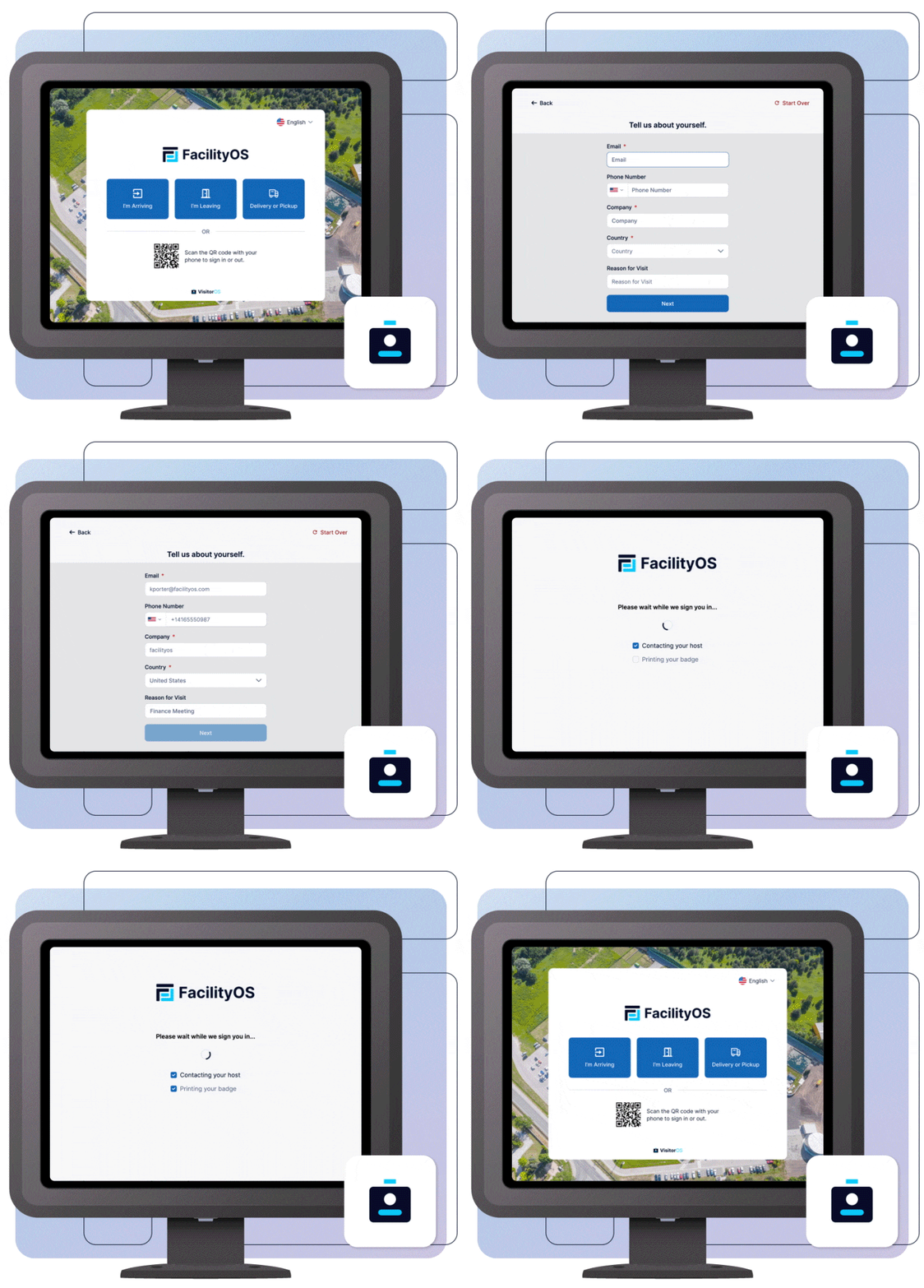
VisitorOS is built around the requirements a mature GMP visitor program needs to cover: pre-arrival approval workflows, identity verification at check-in, GMP induction training delivery and logging, hygiene screening, digital agreement collection, zone-based access control, and a complete audit log of every visitor interaction from first request to departure. Each of these capabilities addresses a specific GMP documentation or access control requirement, and they operate within a single platform rather than across disconnected tools.
For contractor-specific workflows, VisitorOS and ContractorOS are designed to sync seamlessly, so contractor compliance records are automatically verified during check-in and every step is captured in a shared audit trail.
For facilities whose current program relies on paper, email chains, or general-purpose software that was not built for regulated environments, VisitorOS closes the gap between having a visitor policy and being able to demonstrate that the policy was followed.

Frequently Asked Questions: GMP & Visitor Management
What are the GMP requirements for visitor and contractor access?
GMP regulations require facilities to restrict access to production areas to authorized individuals, verify that visitors and contractors have completed required induction training before entering, screen for hygiene compliance, collect signed GMP agreements, and maintain complete records of all visitor activity. Those records must be retrievable during regulatory inspections.
How does a visitor management system support GMP compliance?
A digital visitor management system enforces GMP access requirements at the point of entry as part of a consistent workflow. It delivers induction training, collects digital signatures on GMP agreements, screens for hygiene compliance, restricts access by zone and authorization level, and generates a complete, searchable audit trail of every visitor interaction.
What records are required for a GMP audit related to visitor access?
Audit documentation typically includes a log of all individuals who accessed the facility or controlled areas within a defined period, evidence of induction training completion, signed GMP agreements or NDAs, hygiene screening records, a record of which zones were accessed, and documentation of any incidents involving visitors or contractors during their time on-site.
What is the risk of not managing visitor access under GMP?
Inadequate documentation of visitor and contractor access can result in FDA 483 observations, warning letters, or more serious enforcement action. Repeated or unaddressed findings may lead to consent decrees, import alerts, or product recalls. Documentation failures during a customer or third-party audit can also affect supply chain eligibility and certification status.
Does VisitorOS support multi-site GMP compliance?
Yes. VisitorOS allows organizations to configure and enforce consistent access protocols, training requirements, and screening workflows across multiple sites, so GMP visitor management standards are applied uniformly regardless of location.
Does GMP compliance apply to contractors and temporary workers, or just external visitors?
GMP access and documentation requirements apply to anyone who enters a controlled area, regardless of their relationship to the organization. Contractors, temporary workers, equipment vendors, auditors, and supplier representatives must meet the same training, screening, and documentation requirements as external visitors.
This content is an interpretation of GMP compliance requirements and is not legal advice. Organizations should consult their legal and compliance teams regarding their specific regulatory obligations.
 Streamline Your Visitor Program
Streamline and automate your visitor management operations to achieve ITAR regulatory compliance, enforce safety protocols, and drive site security requirements.