



Build your knowledge with practical, industry-specific guides that help you strengthen compliance, streamline operations, and create safer workplaces.
ITAR (International Traffic in Arms Regulations) is a U.S. regulatory framework that controls the export and handling of defense-related articles, services, and technical data. Any facility that manufactures, stores, or handles items on the United States Munitions List is subject to ITAR, and compliance extends beyond export licensing to include strict controls over who can physically access areas where controlled materials are present. That includes aerospace and defense contractors, but also their suppliers, subcontractors, research partners, and any other organization in the supply chain. Visitor management is one of the most operationally demanding parts of meeting these requirements.
What Is ITAR?
The International Traffic in Arms Regulations (ITAR) is a set of U.S. government regulations administered by the Department of State's Directorate of Defense Trade Controls (DDTC). ITAR governs the export and import of defense-related articles, services, and technical data as defined in the United States Munitions List (USML).
The regulations exist to prevent sensitive military and defense technology from reaching unauthorized individuals or foreign entities. They cover not just the physical export of goods, but also the sharing of technical data. That includes verbal conversations, visual access, and any transfer of information that could occur when an unauthorized person enters a facility where controlled materials are present.
Who Does ITAR Apply To?
ITAR applies broadly to any organization involved in the manufacture, export, brokering, or handling of defense articles and services listed on the USML. That obviously includes defense contractors and aerospace manufacturers, but the obligation extends well beyond them. Subcontractors, component suppliers, machine shops, universities with defense research programs, technology companies whose work touches USML-listed applications, and logistics providers who handle controlled materials are all in scope. If you're anywhere in the supply chain, ITAR's requirements follow.
Under ITAR, a "U.S. person" includes U.S. citizens, lawful permanent residents, protected individuals under 8 U.S.C. 1324b(a)(3), and organizations incorporated under U.S. law. Access to ITAR-controlled articles and data is generally restricted to U.S. persons unless a specific license or exemption applies.
If your facility handles anything on the USML, whether you manufacture components, store technical data, or simply host meetings where controlled information is discussed, ITAR's visitor access requirements apply to you.
Where ITAR Meets Visitor Management
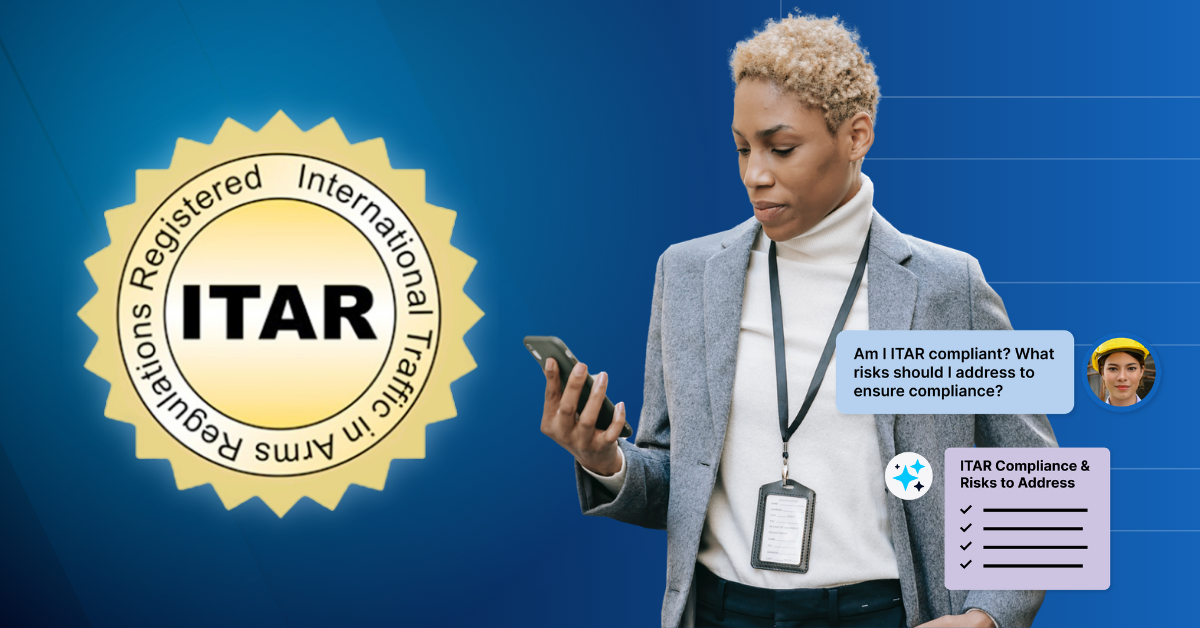
ITAR is usually discussed as an export regulation, but the part that creates the most daily operational burden is physical access control. The connection is a concept called "deemed exports."
A deemed export happens when ITAR-controlled technical data is shared with a foreign national, even if nothing physically leaves the country. Sharing doesn't have to be intentional. If a foreign national walks past a workstation displaying controlled engineering drawings, or sits in on a meeting where ITAR-covered specifications are discussed, that exposure alone can qualify. The data didn't leave the building, but under ITAR, it was still "exported" to someone who wasn't authorized to receive it.
This is the link between ITAR and visitor management. Every person who enters your facility is a potential access point to controlled information, and the DDTC expects you to treat it that way. That means verifying who visitors are before they arrive, confirming they're authorized to be in spaces where controlled materials exist, restricting their movement to approved areas, and keeping records that prove you did all of this consistently.
A facility's visitor management program should be built to help prevent unauthorized exposure.
ITAR Requirements for Visitor Access
ITAR establishes clear expectations that any compliant visitor management program must meet:
Identity verification. Organizations must confirm the identity of every visitor before granting access to areas containing defense-related articles or technical data. This includes scanning government-issued identification, verifying citizenship or residency status, while confirming that the person standing in your lobby is who they claim to be.
Restricted party screening. Visitors must be screened against denied and restricted party lists before being allowed into the facility. These include the Consolidated Screening List maintained by Trade.gov, as well as third-party screening databases. If someone appears on a denied parties list, they cannot be granted access.
Access restriction by authorization level. Not everyone who is allowed into the building should be allowed into every room. ITAR-controlled zones (labs, production floors, secure storage areas) require additional layers of authorization. Visitors or contractors should only access spaces that are directly relevant to their approved purpose of visit, and sites must enforce these boundaries.
Legal acknowledgments. Visitors may be required to review and sign Non-Disclosure Agreements (NDAs) or other legal documents before gaining entry. These acknowledgments must be collected, stored, and tied to the individual visitor record for retrieval during audits.
Record-keeping. Every visit must be logged with enough detail to reconstruct what happened: who visited, when they arrived and departed, the stated purpose of the visit, which areas they accessed, who approved their entry, and what documents they signed. These records must be retained and available for inspection by the DDTC at any time.
Visitor Program Maturity & ITAR Compliance
How well your visitor management program holds up under ITAR depends largely on how mature it is. A facility using paper sign-in sheets and a facility using a purpose-built visitor management system are both "managing visitors," but only one of them can produce the documentation, screening records, and access logs that the DDTC expects to see during an audit.
Visitor management maturity essentially represents whether your processes can consistently meet every ITAR visitor access requirement, every time, for every individual who arrives onsite, and whether you can prove it after the fact.
Manual and Paper-Based Programs
At the lowest maturity level, facilities manage visitors with sign-in sheets, paper logbooks, generic plastic badges, and email-based approval chains. This approach captures basic information (a name, a time, maybe a signature) but leaves significant gaps when measured against ITAR requirements.
The issues compound quickly in practice. Screening against denied party lists depends on someone remembering to run the check, and there's no system-level enforcement if they don't. Approval workflows live in email threads between hosts, security officers, and compliance managers, so visitors sometimes arrive before the chain is complete and get waved through because they're already in the lobby. NDAs get signed on paper but aren't linked to a specific visit record in any retrievable way. Different departments apply different standards depending on who's running the front desk that day.
Temporary and contractor access is where these programs are most exposed. Badges get issued for a specific job and can often never get deactivated when the work ends. An HVAC contractor finishes a two-day repair on Tuesday, returns Thursday for an unrelated job in a different building, and the original badge still opens doors to the controlled production area. The access log now shows an unauthorized entry into an ITAR zone two days after the approved work window closed. During a DDTC review, that entry requires an explanation, and the facility has no documented process to point to.
The fundamental problem with manual programs is that compliance depends entirely on individual discipline and memory.
When the process runs on people remembering to do things (screen this visitor, deactivate that badge, file this NDA), gaps are inevitable. And in an ITAR context, a single gap is a potential violation.

Mature, System-Driven Programs
At a higher maturity level, the visitor management system enforces ITAR requirements as part of its standard operation rather than relying on staff to remember each step.
Pre-Arrival Screening & Approval
Visits are requested, screened, and approved before the visitor sets foot on-site. An internal host submits a request with the visitor's identity details, citizenship status, purpose of visit, and required areas. The system routes the request to designated approvers based on configurable rules tied to the sensitivity of the visit.
Watchlist screening against denied and restricted party databases can run during pre-registration. If screening or approval hasn't cleared, the visitor doesn't receive credentials. The compliance work is front-loaded into the pre-registration phase, so the on-site check-in stays fast and the security-versus-operations tension most facilities deal with is reduced rather than amplified.
Identity Verification & Badging
At arrival, government-issued ID or passport is scanned and verified against the pre-registration record. A printed badge displays the visitor's name, photo, and citizenship status, giving facility personnel an immediate visual reference.
In a busy facility where people move between zones throughout the day, a badge that clearly marks authorization level helps everyone on the floor make quick decisions about who belongs in a given space.
Zone-Based Access Control
Visitor access are configured to grant access only to the specific areas approved for that visit and is labelled clearly on their badge and within the system. If a visitor is cleared for the main conference room but not the adjacent engineering lab, the access control system enforces that boundary and logs any denied attempts.
Escorts are helpful but unreliable as a sole control since they get pulled away, take calls, or assume the visitor knows the route. The system doesn't have those lapses.
Legal Document Collection
NDAs and compliance acknowledgments are presented digitally before or during check-in. Signed documents are stored and tied to the individual visit record, creating a retrievable chain of evidence showing that the visitor acknowledged restrictions before access was granted.
Time-Bound Access Control & Automatic Expiration
Systems that integrate with physical identity access management (PIAM) systems can enable sites to provide temporary time-based badges that activate at the start of the approved window and deactivate when it ends. No manual badge collection, no deactivation reminders, no lingering access. If a visit needs to be extended, the host submits an extension request through the same approval workflow.
The reason is documented, a new window is set, and the audit trail stays intact. This eliminates the most common compliance failure in ITAR visitor programs: access credentials that remain active after the visit they were issued for has ended.
Audit-Ready Records by Default
Every action in the visitor lifecycle is logged automatically: who requested the visit, who approved it, what screening was performed, when the visitor arrived and departed, which zones they accessed, and what documents they signed. These records are timestamped, searchable, and exportable.
During a DDTC audit, the facility can reconstruct the full history of any visit in minutes rather than spending days pulling together fragments from email threads, spreadsheets, and filing cabinets.
The Maturity Gap in Practice
Most facilities that run into ITAR compliance issues with visitor access aren't negligent. They have policies on paper. The problem is that the tools they use to execute those policies can't keep pace with the requirements. A written policy that says "all visitors must be screened against denied party lists" means very little if the screening step is a manual lookup that gets skipped when the front desk is busy.
The shift from a manual program to a system-driven one closes that gap by moving compliance controls out of people's heads and into the workflow itself. Screening happens because the system won't issue credentials without it. Badges expire because the system deactivates them on schedule. Audit records exist because the system generates them at every step. The policy and the execution stay aligned because the system enforces the connection between them.

Penalties for Non-Compliance
ITAR violations are treated seriously. The DDTC has broad enforcement authority, and penalties can include civil fines of up to $500,000 per violation, criminal fines of up to $1,000,000 per violation, and up to 10 years of imprisonment for individuals involved. The U.S. government may also bar non-compliant organizations from participating in future defense-related imports and exports, which for many companies means an immediate halt to core operations.
Beyond the financial and legal consequences, a violation can trigger reputational damage that affects customer relationships, contract eligibility, and the ability to win future work with defense primes or government agencies.
Put simply: investing in compliant processes now costs far less than responding to an enforcement action later.
FacilityOS for ITAR-Regulated Facilities
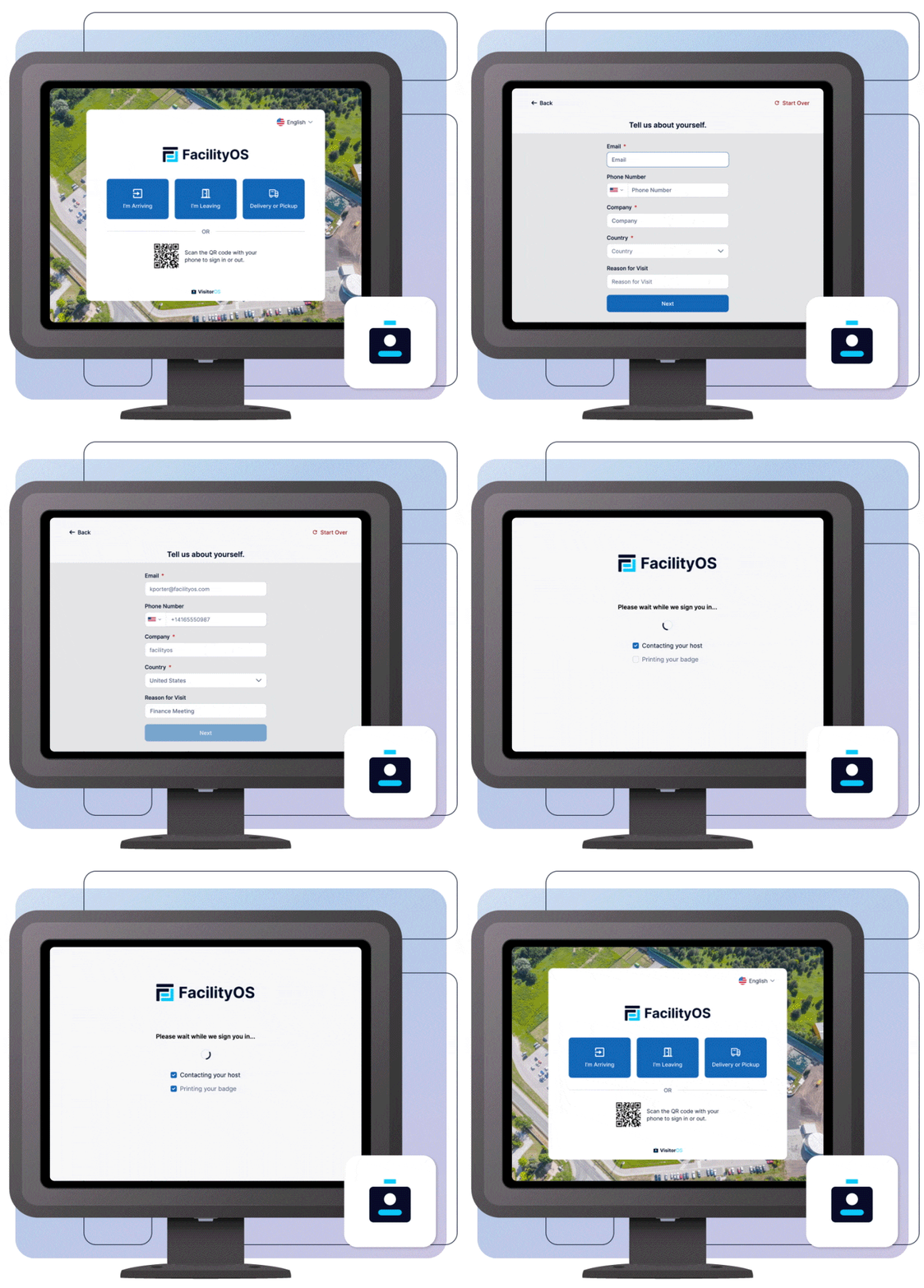
VisitorOS is built around the same requirements a mature ITAR visitor program needs to cover: pre-arrival screening and approval workflows, government ID scanning, watchlist checks against denied and restricted party databases, zone-based access control, digital legal document collection, time-bound credentials with automatic expiration, integration with existing physical security infrastructure, and a complete audit log of every visitor interaction from first request to departure. Each of these capabilities maps directly to what the DDTC expects to see during an inspection, and they work together within a single platform rather than across disconnected tools and manual steps.
For organizations whose current program relies on paper, email chains, or general-purpose software that wasn't built for regulated environments, FacilityOS closes the gap between having a visitor policy and being able to demonstrate that the policy was followed.

Frequently Asked Questions: ITAR & Visitor Management
What does ITAR require for visitor management?
ITAR requires organizations handling defense-related articles and technical data to verify the identity and citizenship status of every visitor, screen against restricted party lists, limit access based on authorization level, collect required legal acknowledgments, and maintain detailed records of all visitor activity. A sign-in sheet does not meet these requirements. Compliant programs need documented, proactive approval processes that happen before a visitor arrives.
Who counts as a "U.S. person" under ITAR?
A U.S. person includes U.S. citizens, lawful permanent residents (green card holders), and protected individuals as defined under 8 U.S.C. 1324b(a)(3). It also includes organizations incorporated under U.S. law. Access to ITAR-controlled articles and data is restricted to U.S. persons unless a specific license or exemption has been granted.
What is a "deemed export" and why does it matter for facility access?
A deemed export occurs when ITAR-controlled technical data is made available to a foreign national, even if the information never physically leaves the country. This can happen through a conversation, a visual observation on a facility tour, or access to a workspace where controlled drawings or data are visible. Controlling who can physically enter ITAR-controlled areas is one of the primary ways facilities prevent deemed exports.
What are the consequences of an ITAR violation related to visitor access?
Penalties can include civil fines of up to $500,000 per incident, criminal fines of up to $1,000,000 per incident, imprisonment of up to 10 years, and suspension of export privileges. For many organizations, losing export privileges halts core operations entirely.
Does ITAR apply to contractors and temporary workers, or just external visitors?
ITAR access requirements apply to anyone who is not an authorized U.S. person, regardless of their relationship to your organization. Contractors, temporary workers, vendors, auditors, and any other non-permanent personnel must go through the same identity verification, screening, and access control processes as external visitors.
How is ITAR different from EAR?
ITAR (administered by the State Department) governs defense articles and services on the USML. The Export Administration Regulations (EAR), administered by the Commerce Department's Bureau of Industry and Security, cover commercial and dual-use items on the Commerce Control List. Some items may be subject to one or both sets of regulations. If your products are on the USML, ITAR takes precedence.
What does an ITAR-compliant visitor management system look like?
At minimum, it should include identity verification through ID or passport scanning, automated screening against denied and restricted party watchlists, configurable approval workflows that require authorization before access is granted, zone-based access restrictions, legal document collection and storage, and a complete digital audit trail that captures the full visitor lifecycle.
This content is an interpretation of ITAR requirements and is not legal advice. It should not replace review by your organization's legal team for your specific compliance needs.
 Streamline Your Visitor Program
Streamline and automate your visitor management operations to achieve ITAR regulatory compliance, enforce safety protocols, and drive site security requirements.









 Manufacturing

Dive into facility management insights for manufacturing industries such as food & beverage, pharmaceutical, automotive, industrial machinery, and more.

 Healthcare
Explore healthcare facility management best practices across facilities such as, hospitals, clinics, medical Laboratories, and rehabilitation centers.
 Education
Dive into facility management best practices across education institutions such as higher education, private schools, and k-12 schools.
 Aerospace, Defense, & Airlines
Get industry-focused guidance in facility management operations for sectors such as aerospace, defense, and aviation & air services.
 Heavy Industry
Explore facility management best practices at scale in heavy industry areas such as waste management, mining, resources, and utility, oil & gas.
 Infrastructure
Dive into facility management 101 for infrastructure industries such as building materials, construction, and engineering & design.
 Corporate & Commercial Industries
Optimize workplace operations across sectors such as media & entertainment, tech companies, financial institutions, real estate, and hospitality.
 Government
Dive into facility management best practices in public-sector environments such as federal facilities, state facilities, municipal facilities, and non-profit.
 Warehouse, Distribution, & Logistics
Keep goods moving across networks such as warehouses, transportation facilities, shipping & distribution centers, and airports & air services.