
A missing visitor induction record earned a major nonconformity from the auditor in Stamp of Approval, an October 2026 webinar hosted by HSE People with FacilityOS. Major is the most serious of the four grades on the webinar's scale, and it came down to a question investigators ask early: what was this person told before they reached the area where the risk sits?
The webinar's example is a UK site, so the regulation it cites is the UK's. Comparable expectations exist internationally in ISO 45001 and in the US under OSHA, so the scenario is relevant to EHS and HSE teams at facilities in any country.
This post covers:
- What the auditor said a visitor induction record should prove
- How a missing record plays out in an investigation, using the webinar's scenario
- Why it earned a major grade, and what UK, ISO 45001 and US OSHA requirements say
- The options for collecting induction records, including paper, spreadsheets and visitor management software
- What an audit-ready record looks like in VisitorOS
What Should a Visitor Induction Record Prove?
A visitor induction record should prove that the right information reached the right person and that the site can show it. The webinar's auditor named four qualities that do this.
Mike Jones, Founder & Principal Consultant at MKJ Assurance and a chartered member of IOSH, was the auditor in the webinar. He described the goal as making sure people "receive the right information, have understood it and that we can demonstrate that afterwards."
The four qualities he named when he approved the webinar's fix:
1
Relevant
It is relevant to where the person is going and the risks they may meet there.
2
Recorded
The record shows who completed it, what information they received and when.
3
Confirmed
A set of questions confirms the person took the information in.
4
Current
The content is reviewed on a regular schedule, so visitors see current site conditions.
He singled out the questions because they turn attendance into evidence that the person understood, and he said it is not just about getting someone to watch a video and tick a box.
The Scenario: A Service Engineer, a Forklift Route & No Induction Record
The webinar used a composite site to illustrate what an investigation looks for. A service engineer recalibrating a filter crosses the packing hall, steps into a marked forklift route and is struck by a truck. He leaves for the hospital with a fractured wrist.
The investigation opens by asking what he was told before he went to the floor. Reception believes he watched the induction video, but nothing confirms it, and the investigation asks for a record showing that the induction ran for this person.
Why the Auditor Graded the Missing Record a Major Nonconformity
Webinar Grading Scale, Least to Most Serious
Conformity
Opportunity for Improvement
Minor
MajorVisitor induction scenario
Attendees graded the scenario in a live poll, and most chose major nonconformity. Jones agreed, because the site had no record of what safety information the engineer received before reaching the production floor. He said he looks for whether the engineer was told about:
- Vehicle movements
- Pedestrian routes
- Restricted areas
- The risks of that part of the site
Jones grades from the documentation side, so the test is what a site can show it provided. He added that organizations often have a process in place but do not always have the evidence that it was followed.
How UK, International & US Requirements Apply to Induction Records
Jones cited UK and international references in the webinar. The US has its own counterparts, and each is linked here:
- UK: Regulation 12 of the Management of Health and Safety at Work Regulations 1999 sets out host employers' duties to people working in their business, including appropriate instructions and clear information about risks. Jones described it as a requirement to provide appropriate information to people coming onto a site's premises.
- International: ISO 45001:2018 is the standard for occupational health and safety management systems. Jones said it expects organizations to manage communication and documented information effectively. Those expectations sit in clauses 7.4 and 7.5, and clause 8.1.4.2 covers contractors.
- US, multi-employer policy: OSHA's multi-employer citation policy lets OSHA cite more than one employer on a worksite for a hazard that violates an OSHA standard, so a host employer can face a citation alongside its contractors.
- US, Process Safety Management: OSHA's letter of interpretation on 29 CFR 1910.119(h)(3)(iii) says contract employee training records must show the employee's identity, the date of training and the means used to verify understanding. It applies to contract employers rather than visitors, and only at covered facilities.
As in the webinar, these references are summaries, not legal advice.
What Are Your Options for Avoiding Missing Induction Records?
The method a site uses to collect induction records is one place to look for gaps. The questions below follow the common setups in order.
Are You Using Manual Methods?
40% of facility teams still track non-employees mainly on paper (EHSLeaders Report 2026). Spreadsheets kept on a computer are often counted as digital, but each entry is still typed and maintained by hand, so this post counts them as manual methods.
FacilityOS's guide to manual vs. digital visitor management systems lists these outcomes of manual methods:
- They are time consuming, error prone and often inefficient.
- They often pose logistical challenges for security staff and visitors.
- They take longer when a facility records more than a sign-in, such as registering visitors, verifying identities, issuing badges and screening, especially at high visitor volumes.
- They require collecting information from each entry point and site, and they leave room for human error.
When induction records are a regulatory requirement, a slow, error prone method can leave gaps or incomplete records, especially when information is spread across systems.
Is Your Induction Data Collected in One Record?
For sites using digital tools, the question is where the induction data lands. A useful check is to pull up one visitor's record and look for the information behind the four qualities Jones named. It is not in one place when:
- One piece sits in SharePoint
- Another is in an email thread
- Another is in a separate folder or system
One place means a single record with the properties the site needs, so everything an auditor asks for is there in one step.
How Flexible Is Your Visitor Management Software?
The induction a site adds to its sign-in workflow should be relevant to where the visitor is going, include questions that check understanding, and be reviewed regularly. The visitor management software then captures proof that the visitor completed it.
Software varies in how much of that it can capture. Some records the check-in and one signed document, while other software lets a site tailor the sign-in workflow for each visitor type. These questions show how flexible a tool is:
- Can it record who completed the induction, and the date and time they completed it?
- Can a quiz be added to the workflow, with the result recorded?
- Can it show which induction the visitor saw, such as a video, a document or a slideshow, and pull it up so an auditor can see what information it contained?
- Can it repeat the induction on a schedule, so regular visitors renew it over time?
- Can different visitor types get different inductions and different workflows?
The Recommended Option: Software That Builds an Audit-Ready Record
FacilityOS recommends visitor management software built around the induction itself, so every visitor's record is complete and audit ready, holding the information a site's audits ask for. VisitorOS, FacilityOS's visitor management solution, is the option FacilityOS recommends.
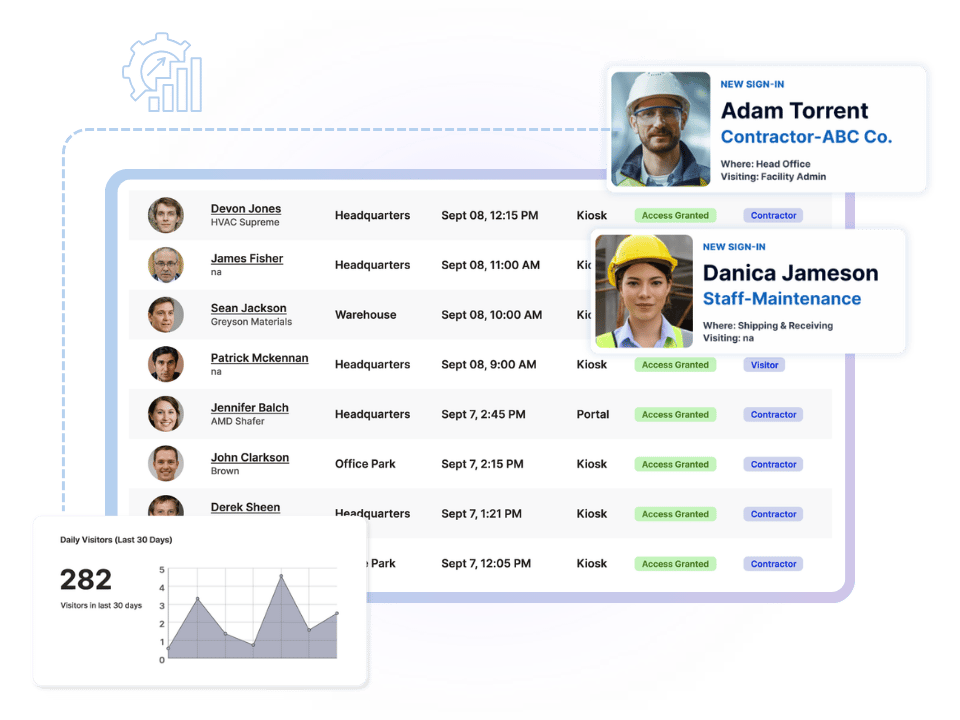
The webinar demonstration showed VisitorOS letting a site:
- Make records complete:
- Set the induction video as mandatory to watch in full, followed by questions that check understanding.
- Set documents and acknowledgments by visitor type, such as service engineers & drivers.
- Make records audit ready:
- Store each completed induction on the visitor's record, with a download for an audit or an investigation.
- Set a document to expire, so a regular visitor repeats the induction at an interval the site chooses, such as every six months, with retention following the site's own policy.
- Make records easy to collect:
- Have visitors complete the induction at the check-in kiosk or through pre-registration, before they reach the production floor.
- Let a visitor who answers incorrectly correct the answer before continuing.
After seeing the demonstration, Jones approved the fix. He added that he would still expect the content to be reviewed regularly.
In the webinar, FacilityOS's Dave Willoughby, Account Director, said that at Valmet, which has 40 sites, an induction that once took 60 minutes now takes five, a reduction of more than 90%.
5 minutes
Valmet contractor induction time across 40 sites, down from 60 minutes, a reduction of more than 90%
Source: FacilityOS webinar, Valmet case study
Frequently Asked Questions About Visitor Induction Records
What Should a Visitor Induction Record Include?
In the webinar, Mike Jones said a strong record shows who completed the induction, what information they received and when. The induction should be relevant to where the person is going, include questions that confirm understanding, and have content that is reviewed regularly.
Is a Watched Video & a Signature Enough?
Jones said in the webinar that it is not just about getting someone to watch a video and tick a box. He described the goal as people receiving the right information, understanding it, and a site being able to demonstrate both afterwards.
Why Was a Missing Induction Record Graded a Major Nonconformity?
Jones said the organization could not demonstrate what safety information the visitor received before going onto the production floor. He graded the scenario from the documentation side, so the missing evidence was the deciding factor.
Which Regulations & Standards Apply to Visitor Inductions?
Jones cited regulation 12 of the UK's Management of Health and Safety at Work Regulations 1999 and ISO 45001. In the US, OSHA's multi-employer citation policy lets OSHA cite more than one employer on a worksite. These are summaries, not legal advice.
How Often Should a Regular Visitor Repeat an Induction?
The webinar demonstration showed a site setting an induction to expire, so a regular visitor repeats it at an interval the site chooses, such as every six months. Jones added that he would expect the content to be reviewed regularly.
How Long Should Induction Records Be Kept?
The webinar demonstration showed retention following the site's own policy, so a site keeps records for the period it sets.
Can Visitors Complete the Induction Before They Arrive?
The webinar showed the same induction steps available at the check-in kiosk and through pre-registration. Visitors can complete them at either point, before they reach the production floor.
See an Audit-Ready Induction Record in VisitorOS
Book a VisitorOS demo to see how a site builds an induction record at check-in and at pre-registration. The full discussion of this scenario, including the auditor's verdict, is in the Stamp of Approval webinar, available on demand.
Stay updated with industry insights, success stories, and more. Follow us on social media for the latest FacilityOS content.
 Follow us on Facebook
 Follow us on X
 Follow us on LinkedIn